

The Flexibility Tipping Point: What Legal Professionals Really Want From Work in 2026
Return-to-office mandates are testing the limits of legal talent retention. Paragon Legal surveyed 130 legal professionals across the U.S. to understand how hybrid and remote work are reshaping burnout, productivity, and career decisions. The findings point to a clear pattern: flexibility appears strongly correlated with retention, performance, and where legal talent chooses to work.
For legal departments managing headcount, workload, and retention pressure simultaneously, the message from the data is clear: flexibility is no longer a perk. It’s a workforce strategy.
Key Takeaways
- 47% of in-office workers are burned out, compared to just 27% of remote workers, despite similar productivity levels.
- 55% of remote and hybrid legal professionals would start job hunting if required to return to the office 3–5 days/week.
- 74% of remote workers would accept a pay cut to retain their flexibility, compared with 39% of in-office workers.
- 32% of legal professionals have relocated since 2020, with 38% moving from metro areas to smaller cities.
Flexibility, Burnout, and the Retention Risk
Burnout in the legal profession isn’t new, but where and how people work are now among its strongest predictors.
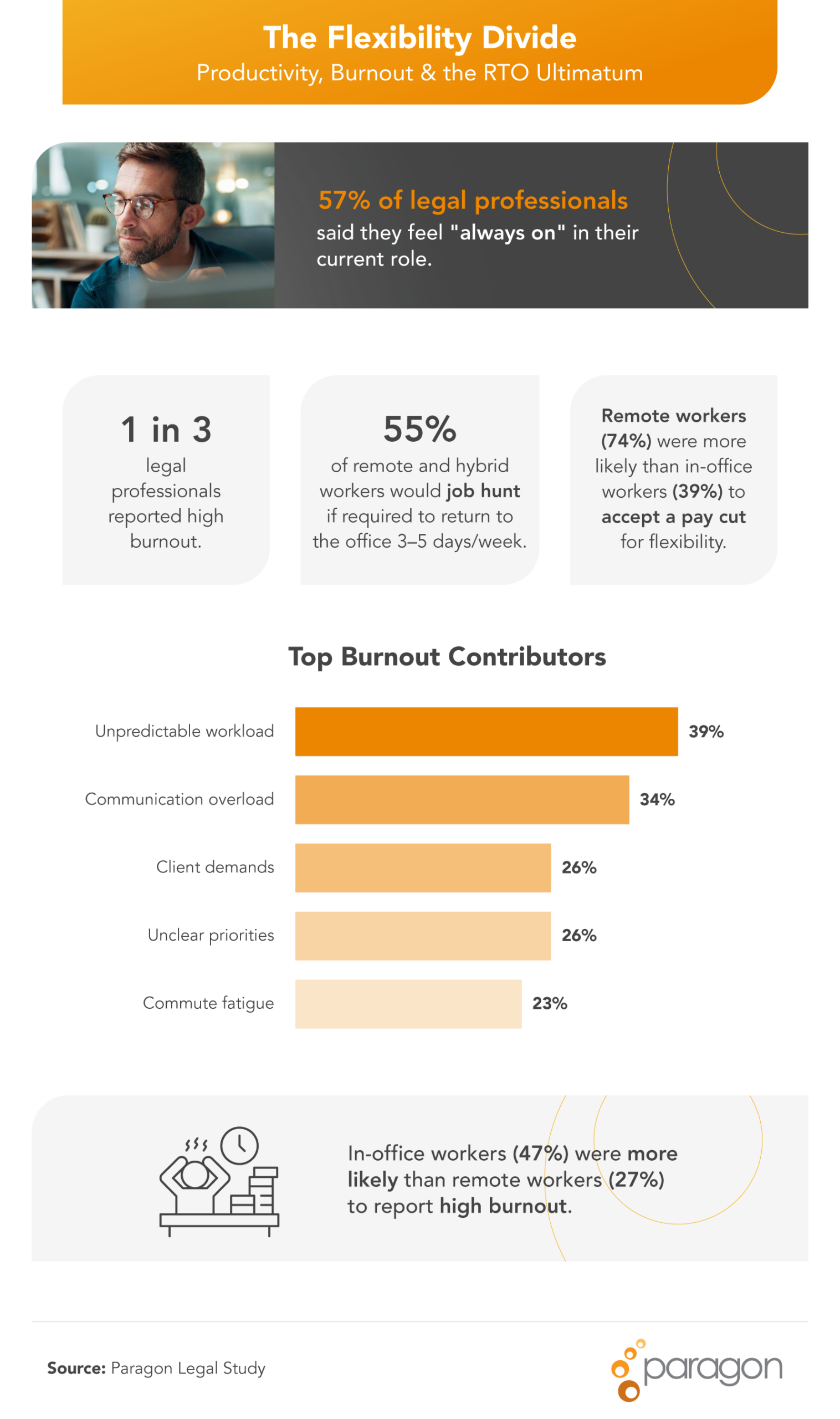
One in three legal professionals reported experiencing high burnout overall. But that number climbs sharply by work arrangement: 47% of in-office workers reported high burnout, compared to 27% of remote workers, even though both groups had similar productivity levels.
Burnout levels by seniority looked like this:
- Associates: 44%
- Partners: 38%
- Counsel: 19%
- Legal ops managers: 33%
- Legal ops individual contributors: 30%
When asked what most affects their work productivity, uninterrupted work time topped the list at 35%. This was followed by commute fatigue (25%) and the ability to focus, whether in the office (22%) or at home (21%). Autonomy over schedule ranked fifth at 19%.
The retention risk is significant when it comes to return-to-office mandates. Over half of remote and hybrid legal professionals (55%) said they would begin job hunting if required to return to the office 3–5 days per week. Among fully remote workers, that number rose to 79%, and even 40% of hybrid workers agreed.
And for many already working outside of the office, flexibility has become worth more than compensation. About 3 in 4 remote workers (74%) were willing to accept a pay cut to preserve flexibility, compared to just 39% of in-office workers.
Career Development and Equity Concerns
Remote and hybrid arrangements raise questions about career development, equity, and job satisfaction.
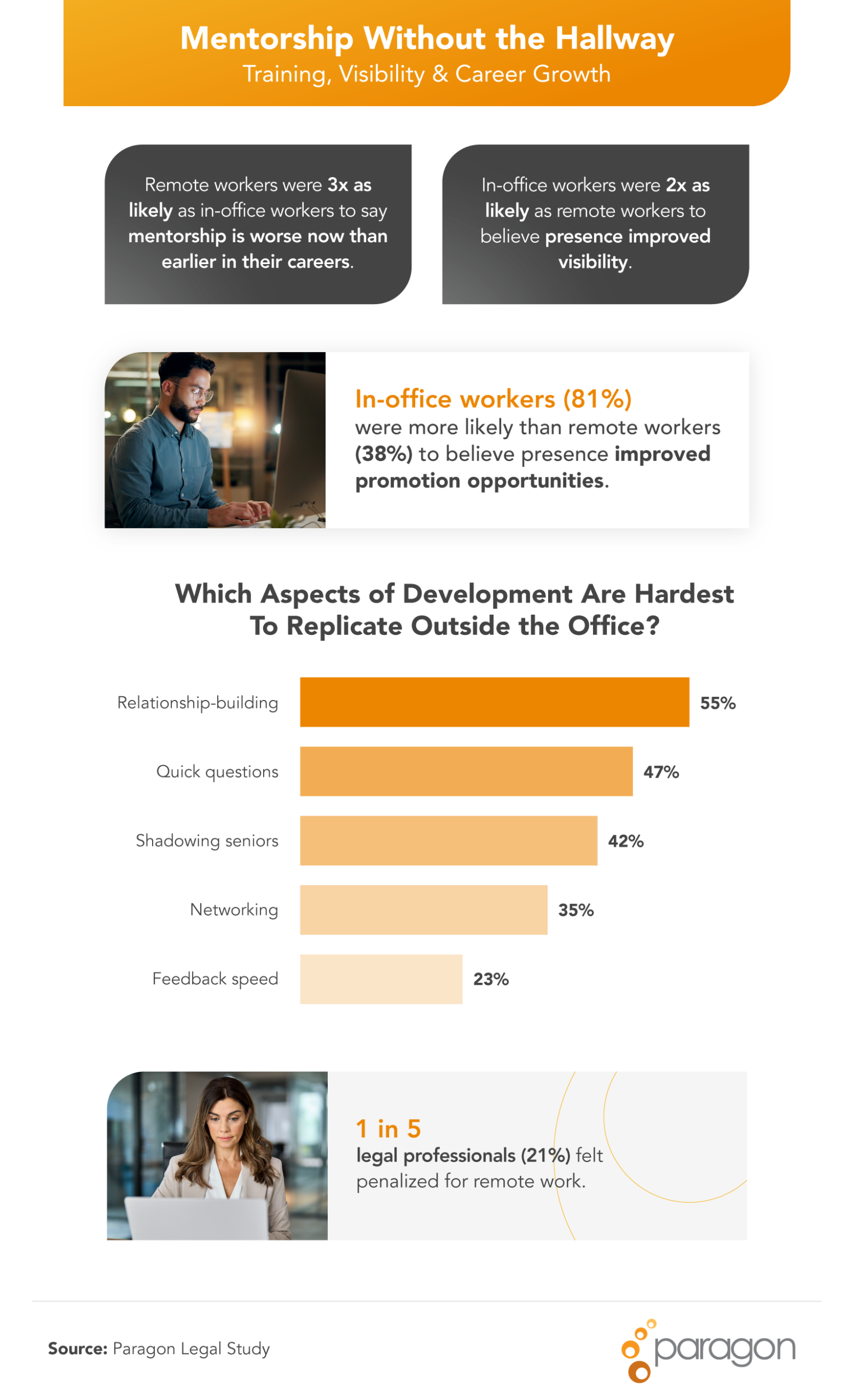
Progress on mentoring and training has largely stalled. Only 23% of legal professionals said it had improved compared to earlier in their careers. Another 23% said it had gotten worse, and 54% said it was about the same.
While 30% of legal professionals agreed their current setup made it harder to learn through observation, 42% disagreed, suggesting the impact varies widely by individual and team.
Equity concerns tell a clearer story. Twenty-one percent of legal professionals overall said they have felt penalized for working remotely.
Flexibility ranked as very or extremely important across seniority levels as follows:
- Legal ops individual contributors: 70%
- Legal ops managers: 67%
- Partners: 63%
- Counsel: 62%
- Associates: 47%
Current and Future Relocation Trends
As flexible work becomes more common, many legal professionals have decided to move.
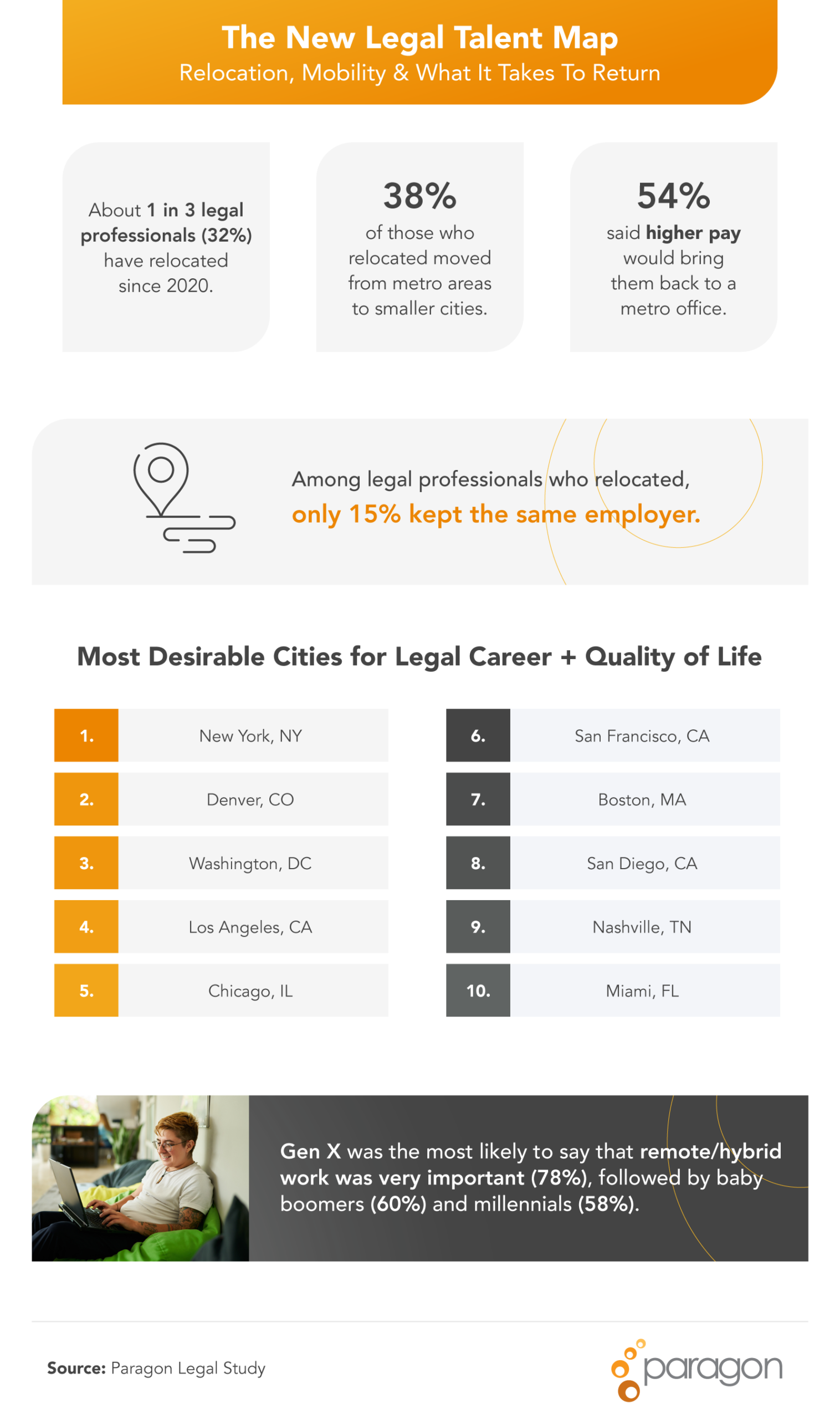
Nearly a third of legal professionals (32%) have relocated since 2020, with 38% of those moving from major metro areas to smaller cities. The top reasons: cost of living, family, lifestyle, and job opportunities, in that order.
Among those who relocated, half were hybrid workers, 28% were fully remote, and 22% worked in-office only. A majority (59%) maintained their salary, but only 15% kept the same employer.
Attitudes around in-office time have shifted as well. In-office workers were nearly twice as likely as remote workers to say they deserved extra paid time off in exchange for coming in (50% vs. 24%), a sign that commuting is increasingly seen as a cost worth compensating.
When asked where they’d most want to live for both career opportunities and quality of life, legal professionals favored major metro hubs: New York, Denver, Washington D.C., Los Angeles, and Chicago topped the list.
The Choice Facing In-House Leaders
The data paints a clear picture: flexibility affects burnout, retention, and even where legal professionals choose to live. Teams that intentionally design flexibility into their workforce strategy — whether through remote-friendly policies, adaptable scheduling, or thoughtful capacity planning — will be better positioned to retain top talent and manage growing workloads. Those that don’t risk losing their best people to organizations that will.
Methodology
Paragon Legal surveyed 130 legal professionals to explore how hybrid and remote work are reshaping productivity, burnout, and retention across the U.S. legal workforce.
The average age of respondents was 40; 67% were women, 31% were men, and 2% preferred not to say. Generationally, 51% were millennials, 31% were Gen X and baby boomers combined, and 19% were Gen Z. By work arrangement, 44% were hybrid, 29% were fully in-office, and 27% were fully remote. The survey did not differentiate between fully remote teams and remote professionals embedded within primarily in-office teams, a distinction likely to shape how mentorship, learning, and perceived equity are experienced. Percentages in this report may not total exactly to 100 due to rounding.
About Paragon Legal
Paragon Legal is on a mission to make in-house legal practice a better experience for everyone. We provide legal departments at leading corporations with high-quality, flexible legal talent to help them meet their changing workload demands. At the same time, we offer talented attorneys and other legal professionals a way to practice law outside the traditional career path, empowering them to achieve both their professional and personal goals.
Fair Use Statement
The information in this article may be used for noncommercial purposes only. If you share it, please provide a link and attribution to Paragon Legal.


 Employee Portal
 Apply
Apply