Where a lawyer launches their career can shape their trajectory just as much as where they went to law school. To help early-career attorneys make more informed decisions about where to plant their roots, Paragon Legal ranked 70 major U.S. metro areas across five key factors: average annual salary, lawyer employment density, projected job openings, rent affordability, and local search demand for legal services.
The result is a data-driven look at which markets offer new lawyers the best combination of opportunity, earning potential, and livability. But the takeaway isn’t simply “move to California.” Knowing how your market stacks up helps you decide whether to compete locally, target a more accessible market, or pursue remote and flexible legal work that isn’t tied to geography at all.
As more legal roles, particularly in-house positions, go remote, a lower-ranked metro no longer has to limit your earning potential or career trajectory.
Key Takeaways
Los Angeles, San Jose, San Francisco, and Sacramento sweep the top four spots, making California the dominant state for lawyer job markets in 2026, led by the highest projected annual job openings of any state at 5,960.
New York has the highest concentration of lawyers of any metro in the study: 10 lawyers per 1,000 jobs.
San Jose leads all 70 metros with an average lawyer salary of $314,430; San Francisco ($275K) and Los Angeles ($271K) round out the top three.
Milwaukee offers the best salary-to-rent ratio of any metro studied: an average lawyer salary of $180K against a median rent of just $1,461 per month.
Where Certain Legal Markets Stand Apart
The top metros for early-career lawyers are not evenly distributed across the country. A handful of markets pull ahead by combining strong projected demand, competitive salaries, and enough open positions to give newer attorneys a realistic path into the profession.
California dominated the top of the rankings, with Los Angeles, San Jose, San Francisco, and Sacramento all placing in the top four. All four metros benefited from the highest projected average annual job openings of any state at 5,960, giving newer lawyers both strong earning potential and meaningful room to break into the market. These openings reflect both newly created positions and replacement demand as attorneys retire or transition out of practice.
Honolulu (#70), Anchorage (#69), and Wichita (#68) ranked as the worst metros for young lawyers. Honolulu landed last, with Hawaii’s state projection of just 120 annual lawyer openings combined with some of the highest rents, making it a difficult market for attorneys just starting out.
A low ranking doesn’t mean a dead end, though. For attorneys in slower markets, remote legal work has changed the math. You can live where rent is less expensive and still access work generated by high-demand markets. The rankings are best read as a map of where demand is concentrated, not a list of where careers are possible.
“For a long time, attorneys treated location as something they were stuck with. That isn’t the case anymore,” said Shannon Murphy, VP of Recruiting at Paragon. “Remote and flexible roles mean a lawyer in a lower-ranked metro can still take on work coming out of the busiest markets. Where you live and where your work comes from no longer have to be the same place.”
What the Data Reveals About Pay, Demand, and Cost of Living
Earning potential, market depth, and affordability vary dramatically across the country, and for new lawyers, all three factors matter when sizing up where to start a career.
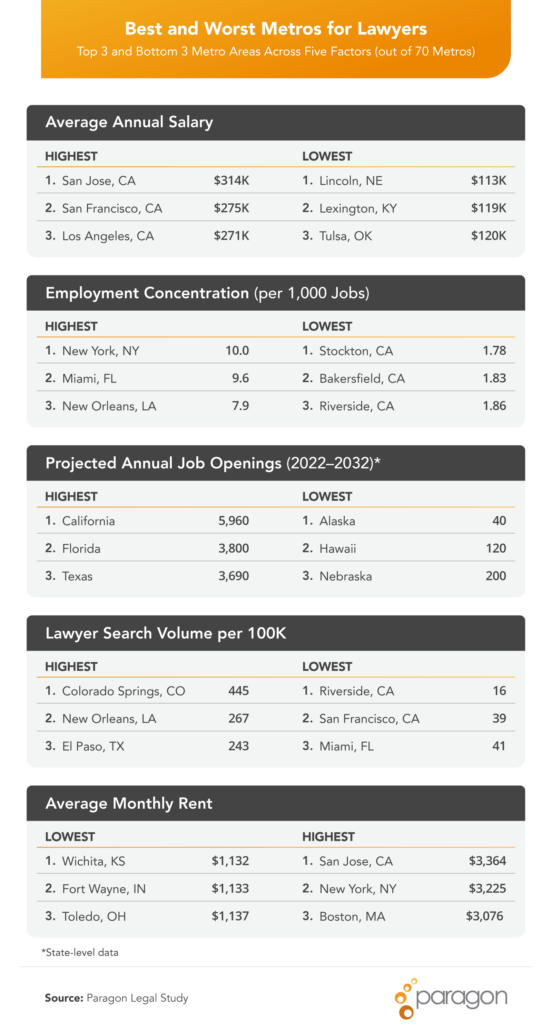
San Jose led all metros with an average lawyer salary of $314,430, with San Francisco ($275K) and Los Angeles ($271K) rounding out the top three. New York ranked first for employment concentration at 10 lawyers per 1,000 jobs, followed by Miami at 9.6 and New Orleans at 7.9. A high concentration signals a more established legal ecosystem with consistent, day-to-day demand for legal services. California projected an average of 5,960 lawyer job openings per year through 2032, the highest of any state.
Colorado Springs ranked first in per-capita lawyer search demand at 445 searches per 100K residents, signaling strong consumer demand for legal services relative to its population. For new lawyers looking to build a book of business, markets where demand outpaces supply can offer a meaningful early advantage.
Salary is only part of the equation. Wichita ($1,132 per month), Fort Wayne ($1,133), and Toledo ($1,137) ranked as the three most affordable rental markets. On the other end, San Jose came in as the most expensive at $3,364 per month, meaning a lawyer in Wichita takes home a far larger share of their earnings despite the salary gap. Milwaukee stood out as the best salary-to-rent value, with an average lawyer salary of $180K paired with rent of just $1,461 per month.
Salary and cost of living should be weighed together. A lower salary in an affordable metro can stretch further than a top salary in the most expensive markets. Flexible legal work, like the roles Paragon offers, many of which are remote, lets attorneys earn competitive pay while living somewhere affordable.
What New Lawyers Should Know About Bar Exam Pass Rates
While the rankings above highlight the strongest labor markets for early-career attorneys, passing the bar is the first hurdle to accessing those opportunities. Below are first-time bar exam pass rates by state, sourced from the National Conference of Bar Examiners (NCBE), to give new lawyers a fuller picture of what breaking into each market requires. We’ve also noted whether each state administers the Uniform Bar Examination (UBE), a standardized exam used by most U.S. jurisdictions.
California metros may fill the top of the previous rankings, but the state ranks near the bottom for first-time bar passage at 44%. Passing the California bar is widely considered one of the most difficult bar exams in the country, and it is a non-UBE state, meaning scores do not transfer from other jurisdictions.
Attorneys pursuing private practice in California should factor that into their career planning alongside the market opportunity. On the other end, Mississippi, Oklahoma, and Virginia reported some of the highest first-time pass rates in the dataset.
Lawyers pursuing in-house roles can have more flexibility. Many corporate legal departments require membership in any U.S. state bar rather than a specific jurisdiction, so passing the bar in a more accessible state can still open the door to competitive markets. Combined with the growth of remote in-house work, this makes the in-house path a practical way for new attorneys to sidestep both the toughest bar exams and the highest-rent metros.
Top 5 States With the Highest First-Timer Bar Exam Pass Rate
Mississippi (82%)
Oklahoma (79%)
Virginia (77%)
Hawaii (76%)
Utah (76%)
Bottom 5 States With the Lowest First-Timer Bar Exam Pass Rate
New Hampshire (30%)
New Jersey (40%)
California (44%)
Alaska (44%)
Connecticut (44%)
“My advice to new lawyers is not to lean too hard on any single ranking,” shared Murphy. “Get clear on what matters most to you, whether that’s pay, affordability, or flexibility, and build your strategy around it. The in-house path gives you real room here, since you can often pass the bar in a more accessible state and still reach competitive work.”
Location Can Be a Career Decision
For lawyers entering the profession, geography can affect how much you earn, how quickly you can break into the market, and how far your paycheck stretches. California’s metros offer the strongest combination of salary and projected opportunity, while mid-sized Midwest and Sun Belt markets make a compelling case for affordability and demand.
But location is becoming a variable you can control rather than a constraint you inherit. Remote and flexible legal roles let attorneys access high-value work regardless of their zip code. Whether you’re weighing a move to a top-ranked metro or building a career from a more affordable one, the smartest play is matching your market strategy to your priorities, whether that’s salary, affordability, market depth, or the freedom to work from anywhere.
Methodology
To identify the best metro areas for lawyers, Paragon Legal ranked 70 major U.S. metropolitan statistical areas across five weighted metrics. All metrics were min-max normalized to a 0 to 100 scale and combined into a composite score. Washington, D.C. was excluded from the ranking as no state-level occupational projection data exists for the District of Columbia.
Average Annual Salary (25%): To measure earning potential, we collected average annual lawyer salaries from the U.S. Bureau of Labor Statistics Occupational Employment and Wage Statistics (OEWS) program at the metropolitan statistical area level for SOC code 23-1011 (Lawyers). Each metro was assigned its own distinct BLS figure. Higher salaries received higher scores.
Employment Concentration (25%): To capture the depth of each metro’s legal labor market, we used BLS OEWS employment per 1,000 jobs, a location quotient-style measure that reflects how lawyer-dense a market is relative to its overall workforce. A higher concentration indicates a more established local legal ecosystem and greater day-to-day demand for legal services. Higher concentration received higher scores.
Projected Annual Job Openings (20%): To account for future market entry opportunities (particularly relevant for early-career lawyers), we sourced state-level long-term occupational projections from ProjectionsCentral.org (2022–2032). The figure used is the projected average annual job openings for lawyers. Each metro was assigned its state’s figure. Higher projected openings received higher scores. State projection figures only reflect the states represented in the 70-metro dataset, not all 50 states.
Rent Affordability (20%): To reflect the real cost of living for early-career lawyers who are more likely to be renters than homeowners, we used the Zillow Observed Rent Index (ZORI) at the MSA level, averaged across all available monthly observations for 2025 and 2026 (January 2025 through February 2026; 14 months). ZORI measures typical asking rents across all unit types and is seasonally smoothed. This metric was inversely scored, where a lower rent received a higher affordability score.
Search Demand per 100K Residents (10%): As a proxy for local consumer and business demand for legal services, we collected city-level monthly Google Trends search volume for the keyword “lawyers near me” across 2025 and 2026. For metros comprising multiple cities, search volumes were summed across all constituent cities. This metric carries the lowest weight, given its indirect nature as a demand signal. Higher per-capita search volume received higher scores.
First-time bar exam pass rates and passing scores by state were sourced from the NCBE and are based on the February 2026 bar exam administration. The UBE designation was also sourced from the NCBE. First-time pass rate data were not available for all jurisdictions. This data is presented for informational purposes only and was not used as a factor in the composite ranking.
About Paragon Legal
Paragon Legal is on a mission to make in-house legal practice a better experience for everyone. We provide legal departments at leading corporations with high-quality, flexible legal talent to help them meet their changing workload demands. For talented attorneys and other legal professionals, we offer a way to practice law outside the traditional career path, empowering them to achieve both their professional and personal goals.
Fair Use Statement
The data and findings in this article may be used for noncommercial purposes only. Any use or republication of this content must include a link and proper attribution to Paragon Legal.





 Employee Portal
 Apply
Apply