Flexibility has become a strategic lever for attracting and retaining high-quality legal talent. It’s changing how employers reach legal professionals across geographies, access specialized expertise, scale efficiently, and retain those who might otherwise leave the workforce.
A recent survey of 214 U.S. legal pros shows just how much friction return-to-office (RTO) mandates are creating in compensation expectations, hiring decisions, and perceptions of productivity. For legal leaders, flexible and hybrid models can no longer be treated as workplace perks. They are how high-functioning teams are now being built.
Key Takeaways
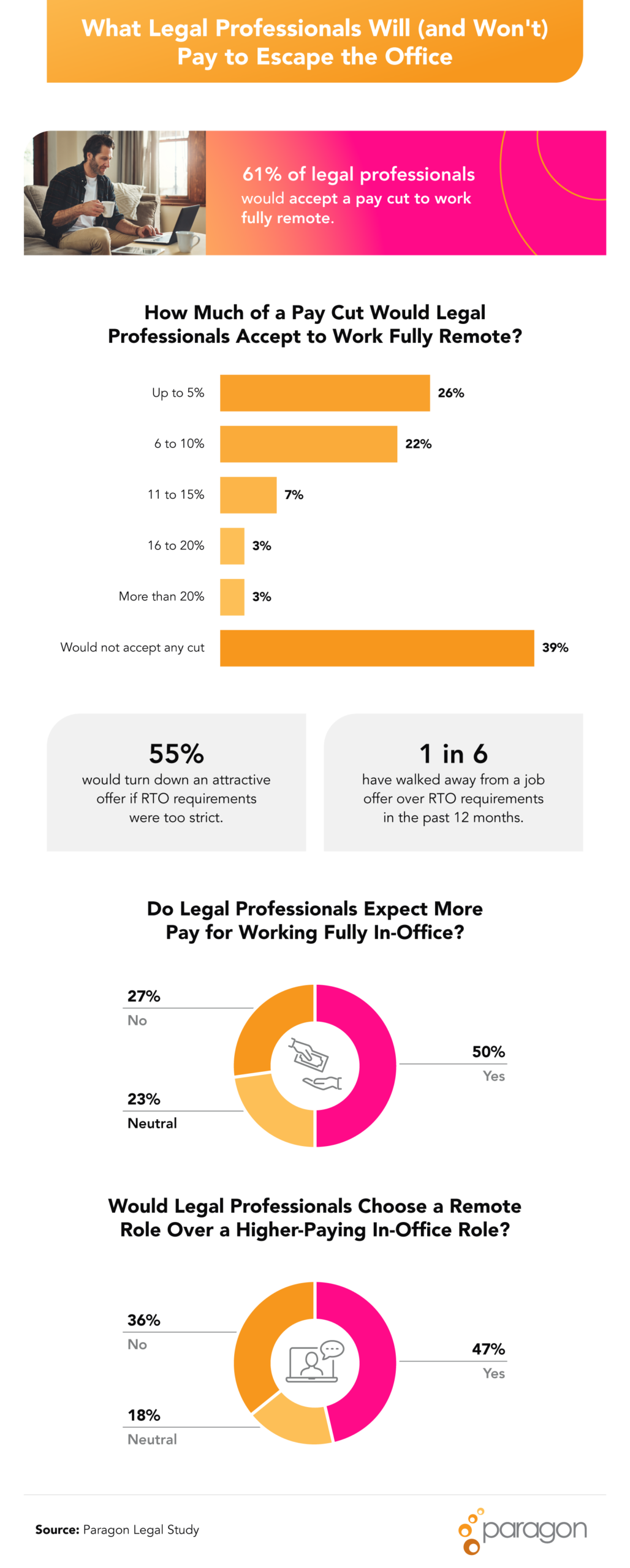
61% of legal professionals would accept a pay cut to work fully remote.
48% of legal professionals would accept a pay cut of up to 10% of their salary to work fully remote.
16% of legal professionals have refused or walked away from a job over RTO requirements in the past 12 months.
Only 30% of legal professionals agree that in-office time improves the quality of legal work product, versus 40% who disagree.
How Flexibility Is Influencing Legal Career Decisions
In-office work has real value in the right context. Intentional collaboration, relationship-building, and certain high-stakes matters can benefit from being in the same room. But the data shows that legal professionals sometimes make career decisions based on how much flexibility they are offered.
61% of legal professionals would accept a pay cut to work fully remote.
Nearly 1 in 2 legal professionals (48%) would accept a pay cut of up to 10% of their salary to work fully remote.
30% of legal professionals say in-office time improves the quality of legal work product, fewer than the 40% who disagree.
Fully in-office: 48%
Hybrid: 29%
Fully remote: 8%
39% of legal professionals say in-office time improves productivity.
Fully in-office: 60%
Hybrid: 43%
Fully remote: 4%
31% of remote legal professionals have refused a job over RTO in the past 12 months (vs. 16% overall), nearly double the average.
Nearly 3 in 4 remote legal professionals (74%) expect to be paid more for in-office work.
“Flexibility isn’t just about where people work. It expands who employers can hire. Some of the most skilled legal professionals have stepped back from traditional practice because the terms didn’t work for their lives. When employers build flexibility into how they operate, they stop competing for the same local pool and start accessing talent they couldn’t reach before.”
— Shannon Murphy, VP of Recruiting, Paragon Legal
How RTO Policies Are Playing Out
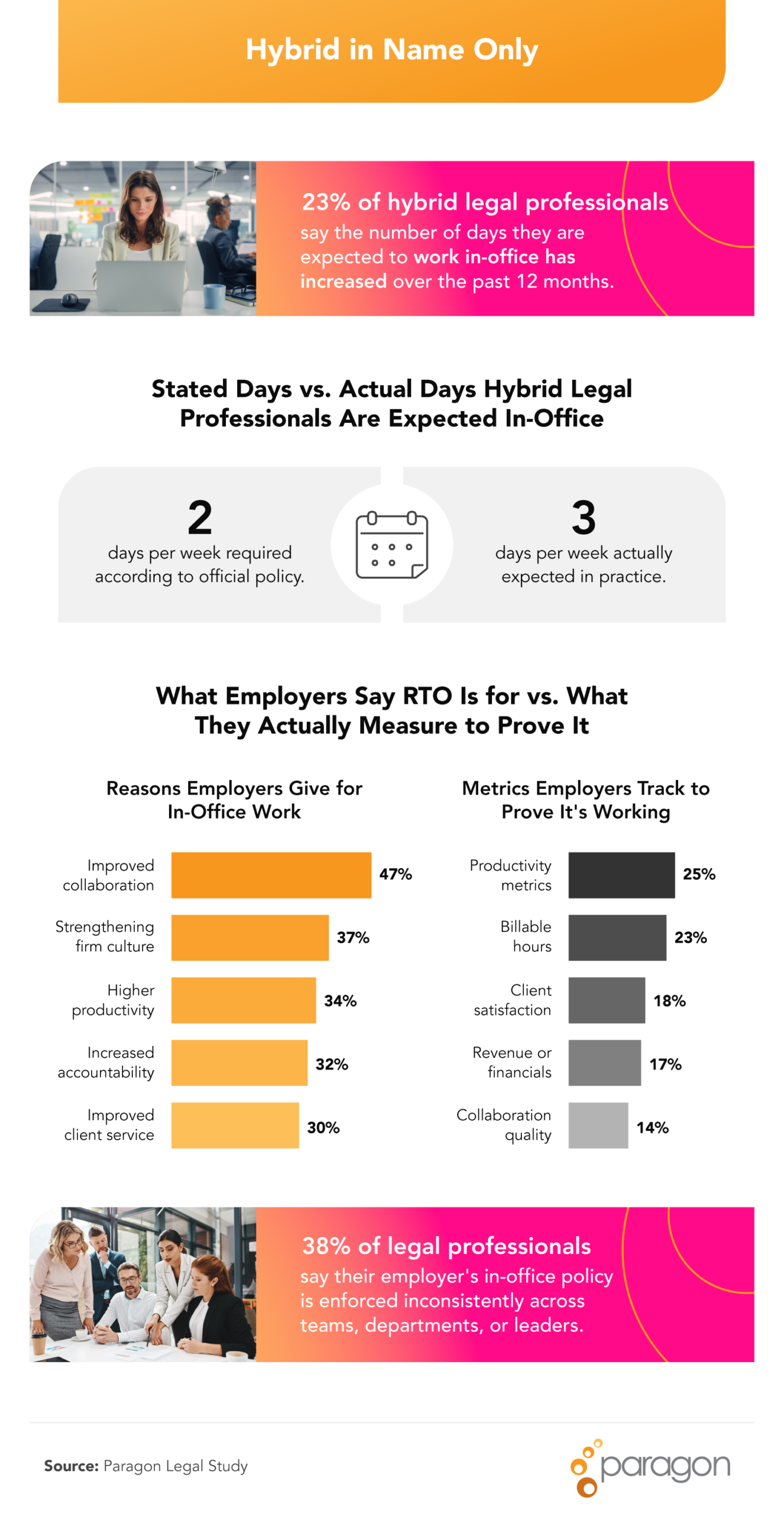
RTO policy and practice don’t always match. Hybrid legal professionals report being expected in the office more days than official policy requires, and some say those expectations have increased over the past year. Hiring leaders have also lost candidates over RTO.
Over 1 in 5 hybrid legal professionals (23%) say the number of days they are expected to work in-office has increased over the past 12 months.
Hybrid legal professionals are required to work in-office 2 days per week according to official policy, but actually expected to be in 3 days in practice.
Among hiring leaders, 27% said they have lost at least one candidate over RTO in the past 12 months. When this happened, the employer did the following to try to close the offer:
Held firm and accepted losing the candidate: 25%
Offered additional remote or flexible days: 20%
Increased base compensation: 12%
Offered a signing bonus or other financial incentive: 11%
Reduced the in-office requirement entirely: 7%
Offered a higher title: 5%
The response data here reflects a relatively small sample, so broad conclusions are hard to draw. What this data shows is that employers are not handling RTO uniformly. In roughly a third of cases, hiring leaders made some kind of concession to save the offer. In others, they let the candidate walk. That inconsistency signals that flexibility is negotiable in many situations, and that candidates often have more leverage than they realize.
“When RTO becomes a sticking point in hiring, employers end up spending more time and money than expected renegotiating offers, increasing compensation, delaying critical support, or restarting the search altogether. At Paragon, flexible legal talent is already the model, helping legal departments quickly access experienced attorneys while reducing hiring friction, containing costs, and scaling support more strategically as business needs evolve.”
— Shannon Murphy, VP of Recruiting, Paragon Legal
Methodology
We surveyed 214 U.S. legal professionals about how return-to-office mandates are reshaping their pay expectations, hiring decisions, and views on whether in-office work actually delivers what employers claim it does. Respondents represented a mix of practice areas, employer types, and seniority levels across private practice, in-house, and government legal roles. Respondents spanned paralegals and legal operations professionals (45%), other legal roles (13%), junior or mid-level associates (12%), senior associates and counsel (12%), equity and non-equity partners (10%), and in-house attorneys (8%). The generational breakdown was 52% millennials, 23% Gen X, 16% Gen Z, and 8% baby boomers. Data was collected in April 2026.
About Paragon Legal
Paragon provides legal departments at leading corporations with high-quality, flexible legal talent to help them meet their changing workload demands. At the same time, we offer talented attorneys and other legal professionals a way to practice law outside the traditional career path, empowering them to achieve both their professional and personal goals. Learn more at https://paragonlegal.com.
Fair Use Statement
This content may be shared for noncommercial purposes only. If you reference or distribute these findings, please include proper attribution and a link back to Paragon Legal.





 Employee Portal
 Apply
Apply