Interim legal counsel is an experienced attorney who integrates directly into an in-house legal department on a short-term or project-based basis to handle defined legal work. Unlike traditional law firms or staffing placements, these legal professionals act as part of the internal team, supporting business initiatives, managing legal risk, and advancing priorities without adding permanent headcount.
For in-house legal departments facing hiring freezes, sudden spikes in legal work, or specialized needs tied to specific projects, interim legal counsel offers a practical path forward. According to recent hiring trends, in-house legal departments are increasingly turning to interim legal counsel for structured, project-based support rather than short-term stopgaps.
Paragon’s model gives GCs (general counsel) access to vetted senior legal counsel who can hit the ground running, reduce reliance on traditional law firms, and help control overhead costs, all while maintaining continuity inside the business.
The scenarios we discuss below illustrate how interim legal counsel delivers measurable impact when timing, budget, or capacity make a permanent hire impractical.
Why Interim Legal Counsel?
You might choose interim legal counsel because it gives in-house teams experienced, embedded support without the timeline or cost of a permanent hire.
They work inside in-house legal departments, partnering closely with business stakeholders and compliance professionals to support ongoing initiatives. Rather than providing external legal services, interim legal counsel focuses on execution, day-to-day legal work, and operational support across areas such as commercial contracts, corporate governance, regulatory compliance, and technology transactions.
When Does Interim Legal Counsel Make Strategic Sense?
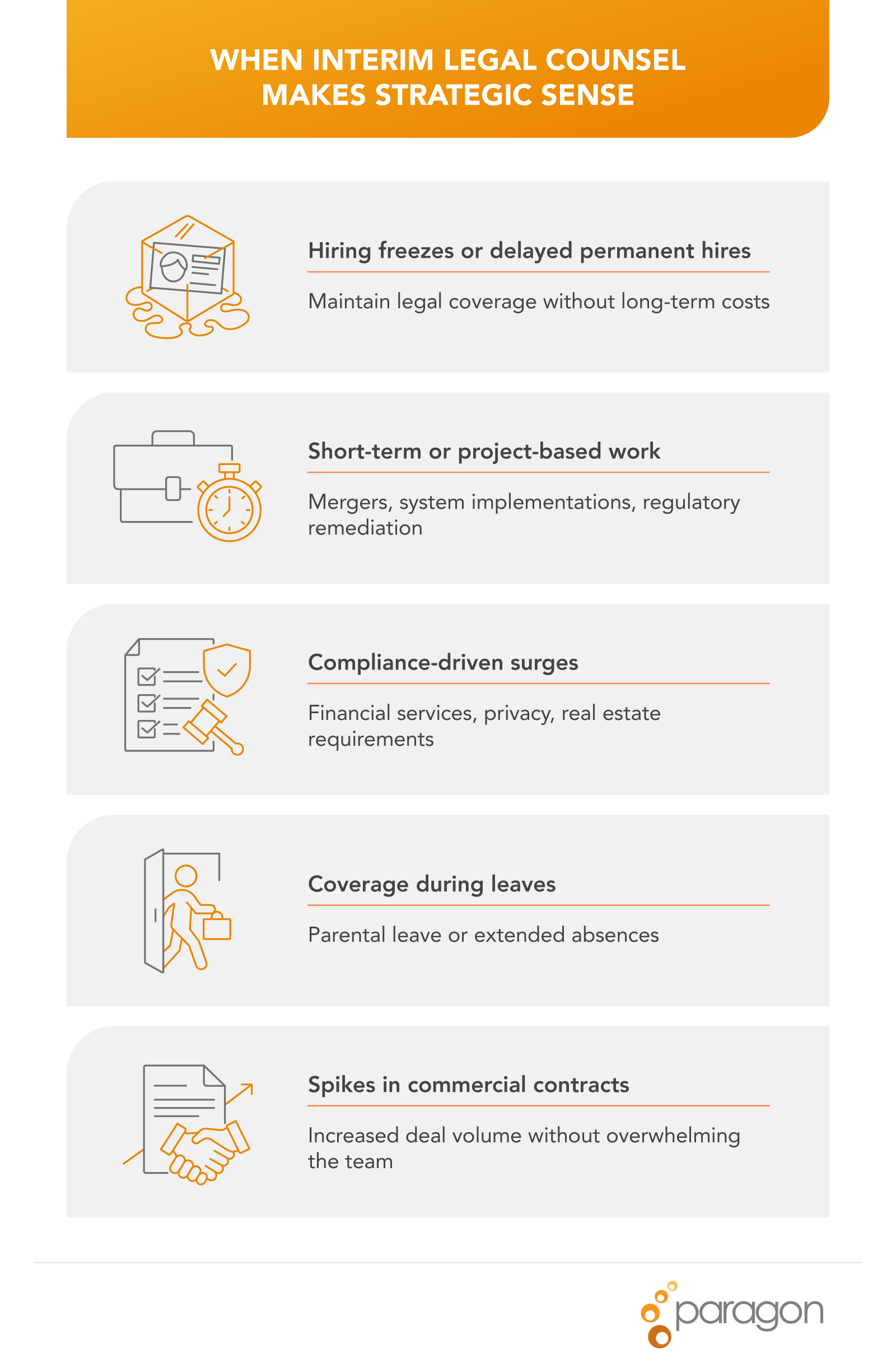
Interim legal counsel is most cost-effective when in-house legal teams need experienced support without committing to permanent roles. Common use cases include:
Hiring freezes or delayed permanent hires. Maintaining legal coverage without increasing headcount or long-term costs
Short-term or project-based work. Supporting initiatives such as mergers, system implementations, or regulatory remediation
Compliance-driven surges. Addressing new or evolving requirements in financial services, privacy, or real estate
Coverage during leaves. Filling gaps created by parental leave or extended absences
Spikes in commercial contracts. Managing increased deal volume without overwhelming internal teams
Year-end or quarter-end spikes. Handling surges in workload tied to fiscal deadlines, contract renewals, or reporting obligations.
These situations often demand speed, flexibility, and proven judgment, making interim legal counsel a reliable talent solution for in-house legal departments.
4 Ways Interim Legal Counsel Drives Impact in Practice
Interim legal counsel delivers the most value when in-house legal departments face real-world constraints, such as limited full-time employees, shifting business priorities, or time-sensitive initiatives.
The following scenarios show how general counsel used interim legal counsel to maintain momentum, reduce risk, and support their teams without committing to permanent hires or overrelying on traditional law firms.
“There are areas of legal work that should be reserved for law firms, but there are areas that are more efficiently done in other ways. And that’s where Paragon fits in.”— Trista Engel, CEO, Paragon Legal
Scenario 1: Finding Support During a Hiring Freeze at Hurricane Games
As Hurricane Games prepared for the launch of its next video game console, an unexpected hiring freeze left the in-house legal department without the ability to add headcount during a critical period. With timelines fixed and legal work increasing, the GC turned to interim legal counsel to provide immediate, in-house support without violating the freeze.
Rather than overloading existing attorneys or relying on traditional law firms, the GC used available vendor budget to bring on an interim legal counsel with intellectual property expertise. The attorney hit the ground running, handled launch-related IP issues, and required minimal onboarding.
As a result, the legal team sustained launch timelines, avoided burnout, and reduced overhead costs compared to outside counsel, all while maintaining the quality and consistency expected of an embedded in-house legal resource.
Scenario 2: Turning Chaos Into Compliance at Fortana
Fortana, an athletic wear company, faced urgent compliance risk when a customer submitted a request under the California Consumer Privacy Act. The in-house legal team lacked specialized privacy expertise, and relying on traditional law firms for day-to-day compliance work would have significantly increased overhead costs.
To support her in-house legal department, the GC engaged interim legal counsel with deep experience in privacy and regulatory compliance. Working alongside internal stakeholders and compliance professionals, the interim attorney partnered with IT to map data flows, centralize customer information, and identify gaps involving sensitive geolocation data. She also created a repeatable internal playbook for handling CCPA requests and reviewed privacy policies to support broader GDPR compliance initiatives.
The interim legal counsel reduced regulatory risk, accelerated Fortana’s response to the CCPA request, and strengthened the company’s long-term compliance posture. Strategic legal judgment remained with in-house leadership and outside counsel as needed, while the interim role focused on execution and implementation, enabling the legal team to move quickly and confidently as privacy requirements evolved.
Scenario 3: Bringing Flexibility to Workflow Management at Nudesk
As demand for NuDesk’s HR software increased, the company engaged interim legal counsel with commercial contracts expertise to support the in-house legal team on a project-based basis. The interim attorney integrated quickly, handling day-to-day legal work while internal teams focused on higher-priority initiatives.
When demand shifted from the HR product to NuDesk’s accounting software, the GC reassigned the interim legal counsel to support the growing business line rather than pursuing a permanent hire. Because the attorney already understood NuDesk’s operations, contracts, and risk tolerance, the transition required minimal ramp-up and preserved continuity across in-house legal departments.
This flexible legal staffing approach helped NuDesk manage short-term spikes in legal work, avoid unnecessary permanent roles, and reduce overhead costs. When another surge occurred months later, the same interim legal counsel returned to support the team, demonstrating how on-demand legal talent can scale with the business without disrupting momentum.
Scenario 4: Maintaining Continuity During Extended Leave at a Cybersecurity Company
When a senior corporate counsel at a cybersecurity company went on extended parental leave, the in-house legal department faced an immediate coverage gap. With a lean team and ongoing demand for commercial contracts and service agreements, shifting the work entirely to traditional law firms would have driven up costs and slowed response times.
To maintain continuity, the head of legal engaged interim legal counsel through Paragon. The interim attorney integrated quickly into the in-house legal department, overseeing contract review, supporting sales-driven turnaround times, and assisting with employment and corporate governance matters. Engaged on a part-time, on-demand basis, the attorney provided flexible support without the overhead costs of a permanent hire.
When another unexpected departure created a second gap months later, the company re-engaged the same interim legal counsel. Because the attorney already understood the business, systems, and risk profile, they were able to plug back in with minimal ramp-up. This approach helped the legal team manage cyclical workloads, reduce disruption, and preserve institutional knowledge, demonstrating how interim legal counsel can provide reliable, repeatable support across changing business needs.
The Strategic Advantage of Interim Counsel
The experiences at Hurricane Games, Fortana, and NuDesk show why interim legal counsel has become a core staffing strategy for in-house legal departments. In each case, interim legal counsel reduced risk, maintained momentum, and helped legal leaders manage shifting priorities without adding permanent roles or increasing reliance on traditional law firms.
Paragon supports this approach by providing vetted, on-demand legal talent that integrates quickly into in-house legal teams. Paragon’s interim legal counsel brings senior-level experience across commercial contracts, compliance, technology transactions, and other critical initiatives, allowing GCs to scale legal capacity, control overhead costs, and keep legal work moving during periods of change. These attorneys operate as true extensions of the in-house legal function, delivering measurable impact while supporting, not replacing, internal leadership and outside counsel where strategic judgment is required.
For legal leaders navigating workload spikes, short-term projects, or evolving business demands, interim legal counsel offers a flexible, proven way to strengthen the legal function without sacrificing quality or continuity.
Ready to strengthen your in-house legal team? Request interim legal counsel from Paragon Legal or talk to us about interim legal support to access:
Speed. Experienced attorneys who can hit the ground running
Flexibility. Project-based and short-term support aligned to business needs
Reduced overhead. Lower costs compared to permanent hires and traditional law firms
Experienced attorneys. Senior legal counsel vetted for in-house legal environments
Frequently Asked Questions About Interim Legal Counsel
The answers below cover common considerations around interim legal support, from timing and scope to how this on-demand approach fits alongside permanent roles and traditional law firms.
How does interim legal counsel work?
Interim legal counsel joins an in-house legal department on a short-term or project-based basis to support defined legal work. These attorneys integrate directly with internal teams, manage day-to-day legal tasks, and report to in-house legal leadership, rather than operating as external legal services like traditional law firms.
When should GCs use interim legal support?
GCs typically use interim legal counsel during hiring freezes, workload spikes, or when specialized expertise is needed for specific projects. Common scenarios include compliance initiatives, mergers, increased volume of commercial contracts, coverage during leaves, or temporary gaps before a full-time, permanent hire is made.
How is interim legal counsel different from a permanent hire?
Interim legal counsel provides experienced, on-demand support without the long-term commitment, overhead costs, or onboarding timeline of permanent roles. This model allows in-house legal departments to scale capacity quickly while maintaining flexibility as business needs evolve.





 Employee Portal
 Apply
Apply