The climb to partner once defined legal ambition. That definition is changing. In a new Paragon Legal survey of 107 licensed attorneys practicing in the U.S., more attorneys strongly agreed that the traditional partner track has lost its appeal than agreed with any other statement about their careers. The pull toward flexible and independent work reaches well beyond a small group. For a broad range of attorneys, it’s now a deliberate choice.
For in-house legal leaders, that change is an opportunity. The attorneys who once seemed locked into the traditional path are now actively choosing flexible roles, which widens the pool of senior talent available to legal departments. The practical takeaway is to treat flexible legal talent as a standing part of your staffing strategy rather than an emergency measure. Paragon Legal helps legal teams do exactly that, matching experienced attorneys to the work when and where demand appears.
Key Takeaways
92% of practicing attorneys say the traditional law firm partner track has lost its appeal.
92% of practicing attorneys are interested in flexible or fractional legal roles.
30% of attorneys rank schedule flexibility as their top priority.
85% of departments expect their use of flexible talent to grow over the next two years.
88% of attorneys believe companies increasingly value flexible and interim legal talent.
Why the Partner Track No Longer Holds the Same Appeal
Attorneys are rethinking what a successful legal career looks like, and the traditional partner track is losing its hold.
The signal is strong across the profession. In the survey, 92% of attorneys agreed the traditional partner track has lost its appeal, and 56% agreed strongly, the highest strong agreement of any career statement tested. Attorneys were decisive about the change.
The view held even among the attorneys closest to the traditional path. Among corporate and M&A attorneys, 98% said the partner track is less appealing than it once was, and the same share called flexible work a viable long-term option. Younger attorneys were the most emphatic: Gen Z respondents were unanimous that the partner track has faded (100%), compared with 87% of millennials.
Attorneys also read the market the same way. Even as many found the traditional track less compelling, 88% believed companies increasingly value flexible legal talent, a sign they see the flexible path as durable rather than a detour. For in-house leaders, that points to a deeper, more reachable pool of senior talent, as attorneys who once aimed only at partner now consider flexible roles.
Trista Engel, CEO of Paragon Legal, sees the change up close:
“Experienced attorneys are increasingly rethinking what a successful legal career can look like. Flexibility is no longer seen as a detour from a serious legal career. For many attorneys, it’s an intentional choice about how they want to do their best work, and that creates a real opportunity for legal teams to access exceptional talent.“
Flexible Talent Is Becoming a Standing Part of Legal Teams
Inside legal departments, flexible talent has moved from occasional help to a regular part of how work gets done.
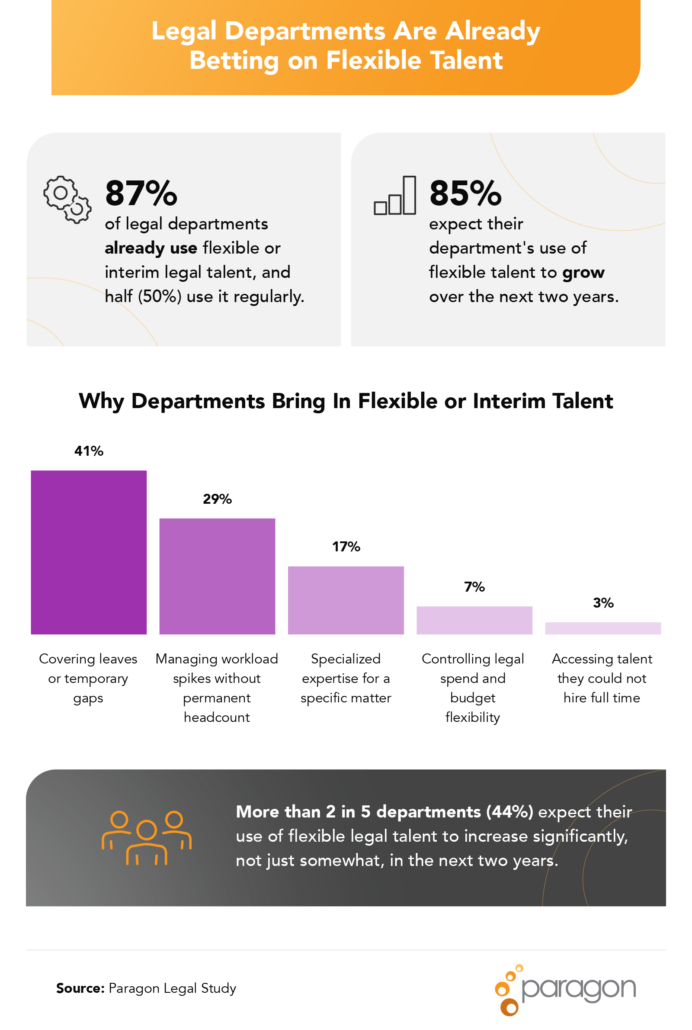
The use is steady and growing. Half of legal departments (50%) used flexible legal talent regularly rather than only occasionally, a sign of a standing role rather than a one-off fix. And 85% expected their use to grow within two years, with 44% anticipating a significant increase on top of the 41% expecting a somewhat larger one.
The reasons centered on capability. Departments turned to flexible talent mainly to cover gaps (41%) and manage workload spikes (29%), while budget control (7%) trailed far behind. The pattern points to rightsourcing, matching the right resource to the work as demand rises and falls. For legal leaders, the practical move is to map where those gaps and spikes recur and line up flexible talent ahead of the next one.
Trista Engel, CEO of Paragon Legal, sees the same trend among the teams she works with:
“The real opportunity with flexible legal talent is to think about it before you need it. When it’s built into your workforce strategy from the start, you have another lever to pull as workloads, priorities and business needs change.“
What This Means for In-House Legal Teams
The takeaway for legal leaders is clear. The attorneys who deliver senior-level work increasingly want flexibility, and they are willing to build their careers around it. That makes flexible legal talent a deep and motivated resource, and the departments already treating it as an ongoing capability are positioned to move faster when the work surges. For general counsel weighing how to staff the next project or workload spike, the opportunity is to plan for flexible legal talent from the start. Paragon Legal connects legal teams with experienced attorneys who embed directly in the department and the workflow, so the right expertise is there exactly when it’s needed.
Methodology
Paragon Legal surveyed 107 licensed attorneys practicing law in the United States to understand how experienced legal professionals view flexible and independent work, what they weigh when they consider it, and how their departments are staffing around it. The survey examined attitudes toward the traditional firm track and flexible legal careers, what attorneys weigh when they consider flexible or independent work, their interest in flexible or fractional roles, and how legal departments currently use and expect to use interim legal talent.
The survey was conducted online in 2026. The average age of respondents was 32. By gender, 83% were men and 17% were women. Generationally, 51% were millennials, 44% were Gen Z and 5% were Gen X.
About Paragon Legal
Paragon Legal is on a mission to make in-house legal practice a better experience for everyone. We provide legal departments at leading corporations with high-quality, flexible legal talent to help them meet their changing workload demands. For talented attorneys and other legal professionals, we offer a way to practice law outside the traditional career path, empowering them to achieve both their professional and personal goals.
Fair Use Statement
The data and findings in this article may be used for noncommercial purposes only. Any use or republication of this content must include a link and proper attribution to Paragon Legal.






 Employee Portal
 Apply
Apply