We get it — your in-house legal team is drowning in work, and all you want is for your CFO to approve interim legal services to ease the burden.
But as a general counsel (GC), your job has more to it than considering only your legal team. Managing your budget is also a huge part of your role. Your CFO expects you to get the highest value for every dollar spent, like every other department leader.
Successfully pitching flexible legal staffing services requires the mindset of a strategic partner. Get a “yes” from your CFO by highlighting these interim counsel benefits.
1. You Get FTE-Caliber Support (Without FTE Costs)
If your in-house legal department struggles to keep internal clients happy, you’re not alone. In-house legal teams across industries are overwhelmed with work, while GCs struggle to hire more full-time employees.
Interim lawyers save the day for your team and your bottom line. You customize their hours based on the work you need, unlike employees who must work a full-time schedule no matter what.
Here are some specific advantages:
Cost-effective solution. Interim attorneys provide flexibility without the expense or long lead times of permanent hires.
Higher efficiency. They operate more seamlessly than outside counsel, who often charge steep rates and lack company context.
Direct collaboration. Working within your team allows them to quickly learn your business model, risk tolerance, and priorities.
Extensive years of experience. Many interim lawyers are seasoned legal experts with decades of experience across corporate, IP, privacy, and commercial law.
Top-tier talent network. These attorneys often come from top-tier firms and prominent in-house legal departments, bringing the same level of skill and insight without the traditional overhead.
An interim counsel accomplishes more with less oversight. They work directly with your in-house team and stakeholders, supporting ongoing projects and legal operations with strong project management skills. Because they understand your company’s business model and objectives, interim counsel can also support broader departmental initiatives, such as process improvement, compliance programs, or contract automation projects.
Talking Points for CFOs About the Merit of Interim Lawyers
Collect testimonials and case studies from the alternative legal services provider you’re considering. Ideally, you should also try to find anecdotes from companies in your industry with similar in-house legal challenges. This is especially helpful for areas with complex or uncommon laws and regulations, such as life sciences, real estate, or technology.
In each case study, highlight what the interim attorneys accomplish and how they’re just as dependable as full-time employees. Provide specific examples and data, where available.
Consider the cybersecurity startup Synack. Paragon’s flexible attorney David helped Synack oversee all contract issues for the company, handled employment questions, and was even available during off-hours for calls. “He was very responsive in terms of making sure that all of his work was timely and we weren’t missing any response time goals,” said Steve Soper, Synack’s Vice President of Legal.
2. It Costs Less Than Outside Counsel and Full-Time Hires
Looking for ways to maximize profitability, your CFO will be happy to hear that on-demand interim talent is the most cost-effective talent solution for in-house legal teams. Flex talent fees are far lower than outside counsel fees, and companies don’t have to pay for the extra costs associated with hiring an FTE — like benefits, bonuses, equity, and onboarding expenses — because your interim agency covers them.
Outside counsel may be worth the higher cost when dealing with very high-risk matters requiring niche legal practice areas. But when it comes to navigating your org and tackling the day-to-day work of your team, an interim attorney will fit the bill. They have the hard and soft skills needed at a far more reasonable price point than other talent solutions.
CFO Talking Points About Interim Counsel Costs
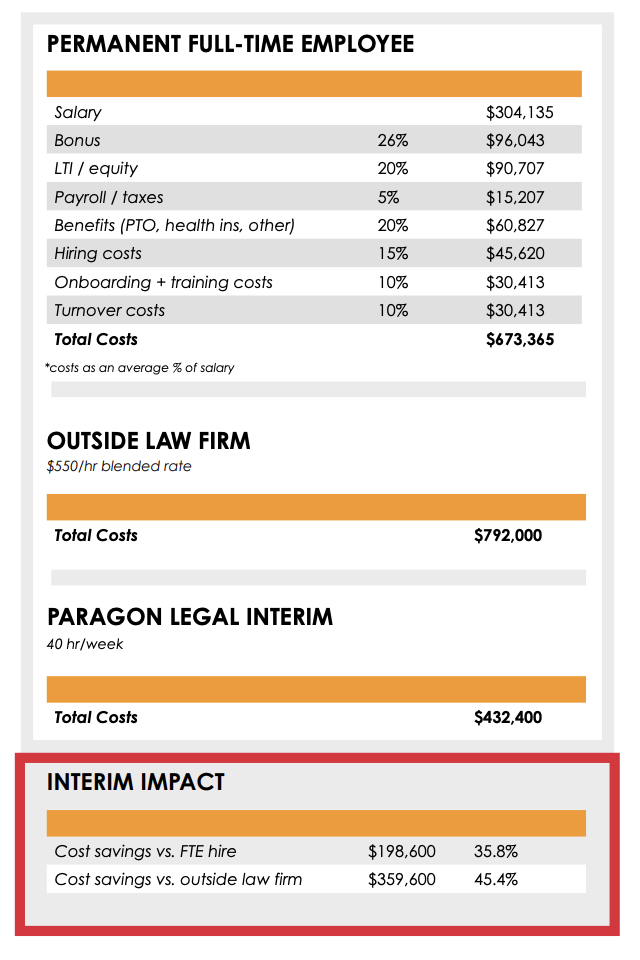
Compare the costs of your prospective interim legal talent provider, outside counsel, and full-time hire expenses. The first two are relatively easy to compare since both have set hourly rates, while full-time hire cost breakdowns depend on the type of attorney you need.
Our resourcing e-book includes several example cost comparison charts, including the one below.
To make it easier to compare these options side by side, here’s a breakdown of the key differences between outside counsel, flex attorneys, and full-time hires. Also provided are typical costs, scalability, and when each solution makes the most sense.
Comparison of In-House Counsel Costs
Option
Annualized cost
Includes benefits?
Scalable?
Common use case
Outside counsel
$790k or more
No
No
High-risk, niche legal work
Full-time employee
$600k or more
Yes
No
Ongoing, consistent internal workload
Interim legal talent
Varies by hours
Yes (covered by vendor)
Yes
Project-based or fluctuating in-house needs
3. You Only Pay for the Work You Need
Many legal workload spikes are predictable (like quarter-end and year-end crunches), but unforeseen business or economic changes can also require immediate legal support. Sudden business or economic changes can quickly create a busy or slow season for your in-house team. During these times, CFOs are reluctant to hire rapidly because headcount budgets are already strained. Sudden layoffs also aren’t ideal since they crush morale and leave you short-staffed when work peaks again.
Considering the uneven nature of in-house legal work, your CFO will be happy to hear that flex talent is a variable cost. You can increase or decrease your interim counsel’s weekly hours based on your team’s workload. For example, a company might have an interim attorney work 20 hours per week in Q3 and ramp up to 40 weekly hours in Q4 to help cover year-end reporting requirements and sales targets.
You can also adjust the duration of your interim counsel engagement to be as short or long as you like. This flexibility is critical for CFOs who want a buffer if the business’s needs change, whether that’s a workload increase or a drop in revenue.
Flexible legal talent is considered a variable cost (unlike salaries and headcount, which are fixed) because it can be turned on or off as needed. This staffing approach helps keep your CFO’s fixed cost base low and often comes from a different budget bucket.
How To Highlight Interim Counsel Flexibility to CFOs
Ask your prospective flexible legal professionals provider for examples of clients who regularly adjust their interim counsel workload.
At Paragon, we like to tell prospects about a 10-year client. Our flex talent makes up half of their legal staff, and the company adjusts their weekly hours based on their need for the attorneys’ specialties.
Along with pulling client stories, map out the ebbs and flows of your in-house team’s work from the last year to show when interim talent would’ve been a cost-saver or potential revenue-booster. Include predictions about work fluctuations over the next year to make the case for investing in flexible counsel now.
4. Interim Talent Doesn’t Impact Legal’s Headcount Budget or RPE
CFOs are under pressure from investors, capital allocators, and executives to keep headcount costs down. According to a summer 2025 Gartner survey, about 64% of CFOs expect their budgets to grow more slowly than projected revenue in 2026. More than half (57%) are looking for the biggest budgetary savings to come from human resources.
Flex legal talent helps CFOs look good on both fronts. Because interim counsel aren’t employees, their costs don’t increase headcount budgets or lower revenue per employee (RPE). Instead, CFOs typically classify flex legal talent as variable cost line items.
Talking to Your CFO About Budgetary Benefits
Emphasize that hiring full-time attorneys raises headcount costs. You’ll add base salaries, benefits, payroll, bonuses, hiring, and onboarding costs to your budget, and RPE will most likely be lower. Because legal departments typically generate little to no income, revenue will stay constant as you add more employees, leading to a lower RPE.
RPE = company revenue / current number of full-time employees
If your team plans to allocate your outside-counsel spending on interim talent, highlight this plan to your CFO. Showing that interim counsel won’t increase the overall budget will help them appreciate that you’re not asking for more funding. In fact, shifting your outside counsel budget to flex counsel will likely lower your team’s overall spend.
As you discuss hypothetical budgets, note that your goal is bigger than choosing the cheapest option. Your in-house team is still getting the same level of talent with flexible counsel as they do with outside counsel or a full-time hire — at a fraction of the cost.
5. Interim Talent Helps Reduce Attrition and Turnover
Year over year, many in-house attorneys struggle with unsustainable workloads. Some even quit their jobs because they’re so burnt out. The expense of such attrition and turnover is a serious concern for CFOs.
Interim talent releases the pressure valve on in-house teams by taking on existing work. This helps in-house attorneys deal with less on their plates, and it helps you design more efficient workflows. For example, you might assign a subset of IP transactions to your flex attorney so your team can build experience on complex strategic partnerships or IP transactions they enjoy.
Here are some ways that hiring interim counsel can decrease turnover:
Custom workflows. You can assign specific projects or transactions to interim counsel to match your team’s strengths and interests.
Cross-department flexibility. Interim counsel can move between departments as needs shift, keeping projects running without disruptions.
Growth opportunities. Their adaptability lets in-house attorneys focus on higher-value or strategic work that aligns with their legal career development.
One reason why interim counsel can successfully shift between departments is their institutional knowledge. GCs trust these attorneys to work across legal teams because they know they have a lay of the land. This experience is also why in-house teams will often re-engage the same flex attorney multiple times.
Interim Counsel and Retention Talking Points for Your CFO Conversation
Share external research with your CFO about in-house counsel job satisfaction. A Bloomberg study showed that a higher percentage of in-house attorneys report heavy workloads as a challenge than law firm attorneys. This data highlights the seriousness of in-house teams’ workloads, helping CFOs understand the need for interim talent.
From there, present your CFO with data about how your in-house lawyers spend their time (you’ll need to ask team members to track their hours). Point out the high-stakes tasks that in-house attorneys need to complete, along with the less important projects that interim counsel could handle.
Emphasize that completing this work with flex talent services offers two key benefits: it’s more affordable than hiring FTEs or outside counsel, and it helps you retain valuable in-house attorneys by taking low-level tasks off their plate.
Pitch Interim Counsel by Becoming a Strategic Partner
As you build your case for flex talent, remember you’re not just a lawyer. Your CFO expects you to be a business leader who can explain interim counsel from a P&L perspective.
Use this post to make a persuasive pitch. Highlight how the variable cost structure of senior legal counsel is a strong defense against unpredictable cycles without requiring your team to compromise on talent.
Interested in learning more about how you can build a business case for your in-house team’s needs? Check out our GC’s Guide to Rightsourcing.





 Employee Portal
 Apply
Apply