When your deal calendar spikes, even a strong in-house function can feel thin. An interim mergers and acquisitions attorney gives your team flexible support across mergers and acquisitions without adding headcount or pulling your core deal team away from high-value decisions. Instead of defaulting every M&A deal to law firms, in-house leaders can match the staffing model to the risk, balancing in-house counsel, law firms, and specialized legal providers.
This model is especially effective across parallel M&A transactions, where due diligence, tracker management, drafting support, and closing coordination can overwhelm internal bandwidth. Interim counsel helps protect corporate governance priorities, maintain internal functionality, and reduce last-minute scrambles that create risk. For legal teams focused on reducing strain without sacrificing quality, learning how to reduce your in-house team’s workload can support a hybrid model that keeps accountability close to the business while maintaining cost control.
When Interim M&A Counsel Makes Sense
Interim M&A counsel tends to make the most sense when the work is time-bound and execution-heavy, but the business still needs your core team available for decisions and stakeholder alignment.
Here are common triggers that point to interim support. If two or more of the following are happening, interim support is likely justified:
M&A deal volume exceeds internal bandwidth Multiple M&A transactions are running in parallel, and your deal team cannot keep up with due diligence, coordination, and execution demands.
Execution work is crowding out strategic oversight Accelerated due diligence review, tracker management, and document flow are pulling your team away from higher-risk decisions and stakeholder alignment.
Post-closing obligations are stretching the M&A team Post-closing tasks, integration work, and contract clean-up are lingering and distracting from new mergers and acquisitions activity.
External parties are compressing deal timelines The acquirer, lenders, investment banks, or other parties are driving tight signing and closing windows that require fast issue triage.
Repeat M&A transactions follow a known playbook Private equity activity, tuck-in acquisitions, divestitures, or spin-offs create a repeat cadence where interim support can execute against established processes.
Routine, small-scale transactions recur frequently If buying or selling small pieces of the business is a normal part of how your company or industry operates, interim counsel can manage these deals end-to-end without the cost of outside counsel or the overhead of a full-time hire.
Use Cases Where Interim M&A Counsel Adds Immediate Value
Interim support adds the most value in situations like these:
Supporting due diligence review for roll-ups across transactions
Managing closing checklists and coordination during recapitalizations
Handling document flow and follow-ups in leveraged buyouts
Coordinating execution for joint ventures and strategic alliances
Providing consistent coverage across repeat M&A transactions for venture capital and private equity programs
Freeing in-house counsel to focus on strategy and stakeholder decisions while interim support handles diligence tracking and document coordination
Temporary Bandwidth Gaps and Deal Spikes
Interim M&A counsel can help stabilize coverage during periods such as:
Parental leave, medical leave, or extended absences within the M&A team
Hiring transitions or delayed backfills that reduce internal capacity
Overlapping M&A transactions that strain available bandwidth
Periods where one or two key lawyers carry a disproportionate share of transaction work
Repeatable or Routine Workstreams (Including Tuck-In Acquisitions)
Interim support is especially useful for repeatable execution work in frequent M&A transactions, including:
Conducting contract-level due diligence for tuck-in acquisitions
Preparing issue summaries for business owners and internal stakeholders
Performing first-pass document clean-up and consistency checks
Managing standardized integration steps tied to a known playbook
Supporting high-volume, repeat M&A transactions where execution speed matters
Post-Acquisition Integration and Contract Hygiene
Interim M&A counsel can support post-close coordination and handoff work before specialist attorneys (commercial, employment, or real estate) take over their respective workstreams. That support can include:
Managing contract assignments, notices, and consent tracking
Coordinating vendor and customer updates tied to mergers and acquisitions
Overseeing operational handoffs across procurement and finance
Tracking follow-through items related to real estate, employee benefits, or intellectual property
Maintaining contract hygiene to prevent downstream legal issues during integration
What Interim M&A Attorneys Do vs. What Should Stay With Law Firms
Interim M&A attorneys add capacity and keep workstreams moving, but they are not always a substitute for outside counsel. In a healthy hybrid model, interim support complements in-house leadership and law firms, rather than competing with them. If you know you’ll get internal questions about quality, onboarding, or oversight, it can help to pre-empt them with the common objections to hiring interim counsel.
Division of Labor: Interim M&A Counsel vs. Law Firms
Workstream
Interim M&A counsel (supports in-house team)
Law firms (lead higher-risk work)
Due diligence
Reviews documents, flags issues, drafts summaries for the deal team
Sets diligence approach for unusual risk profiles and advises on risk tolerance
Process and project management
Runs tracker hygiene, manages data room workflows, coordinates stakeholders
Leads deal cadence and drives negotiation timelines with counterpart counsel
Advises on gating items and resolves high-risk close conditions
Risk positioning
Escalates issues with context and options for in-house decision-makers
Sets market positions on core terms and liability allocation
Specialized areas
Spots issues and routes them to the right owners
Handles tax structuring, regulatory approvals, and specialized sign-offs
Interim M&A Counsel Typically Handles Execution Work
Interim M&A counsel typically steps in once the overall approach is set and the deal needs steady hands on the work. That often looks like due diligence review at scale, issue spotting with clear summaries, and keeping trackers usable for the M&A team and the broader deal team. A dedicated M&A contract attorney can also draft or clean up supporting documents and keep closing checklists current so internal owners are not chasing attachments or guessing which draft is final.
This support matters in the messy middle of M&A transactions, where corporate governance and stakeholder coordination can stall if no one owns the mechanics. Interim attorneys can also prepare escalation notes that tee up decisions for in-house leads, rather than trying to solve strategic questions in a vacuum.
Outside Counsel Should Still Lead These Higher-Risk Areas
The best law firms lead higher-risk and specialized components of mergers and acquisitions, such as:
Setting negotiation strategy and market positions on core deal terms
Advising on tax structuring and complex transaction architecture
Managing regulatory approvals, including antitrust and FTC risk analysis
Leading cross-border transactions involving local law and jurisdiction-specific issues
Handling disclosure-heavy work for public companies with strict process requirements
Advising regulated sectors such as financial services, healthcare, and life sciences
Supporting private equity deals with complex structures or aggressive timelines that require deep bench strength
Regulatory and Specialized Considerations To Flag Early
Certain deal characteristics should shift the resourcing plan early in mergers and acquisitions, including:
Antitrust exposure, FTC filing risk, or competitive overlap that increases regulatory scrutiny
Deals in regulated sectors such as healthcare, life sciences, or financial services with licensing and compliance constraints
Public company transactions involving disclosure obligations and heightened process rigor
Targets with complex regulatory footprints that require specialized outside counsel involvement
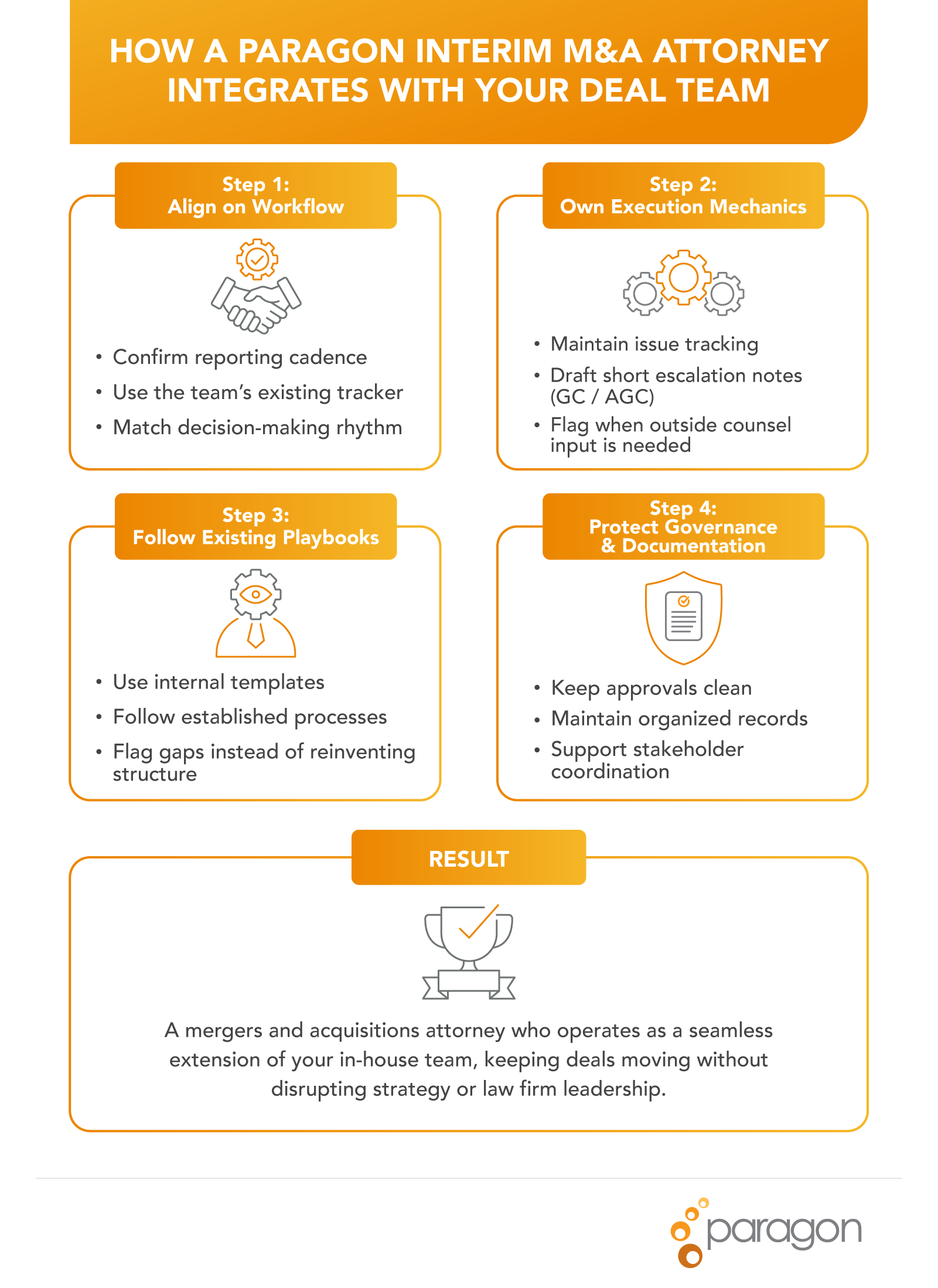
How Paragon Attorneys Integrate With In-House Deal Teams
An interim M&A attorney should operate as a natural extension of your in-house workflow, not as a parallel track. Effective integration starts with structure, clarity, and respect for how your deal team already makes decisions.
Step 1: Align On Workflow
Integration begins by confirming the reporting cadence and communication norms your M&A team already uses. Interim counsel adopts the team’s existing tracker rather than introducing a new system and matches the decision-making rhythm already in place. The goal is continuity, so updates feel familiar, and stakeholders are not adjusting to a new process mid-deal.
Step 2: Own Execution Mechanics
Once aligned, interim support takes ownership of the mechanics that keep mergers and acquisitions moving. That includes maintaining issue tracking, drafting short escalation notes for the GC or AGC, and clearly flagging when outside counsel input is required versus when internal sign-off is sufficient. This keeps higher-level decision-makers focused on risk and negotiation strategy.
Step 3: Follow Existing Playbooks
Interim M&A attorneys work within your established templates and playbooks. They follow defined processes and flag gaps rather than reinventing structure. This approach preserves consistency across transactions and reinforces institutional knowledge within the deal team.
Step 4: Protect Governance And Documentation
Strong execution also protects corporate governance requirements. Interim counsel keeps approvals clean, maintains organized records, and supports stakeholder coordination so documentation remains audit-ready while the transaction progresses.
Result
The result is a mergers and acquisitions attorney who operates as a seamless extension of your in-house team, keeping deals on track without disrupting strategy or law firm leadership. If you need broader support beyond execution, Paragon’s Corporate & Securities Attorneys can assist with adjacent corporate workstreams that surface during M&A.
How Engagement Works
Strong interim M&A engagements are defined less by a rigid sequence and more by clarity around scope, timing, and responsibilities. The most effective arrangements share several core characteristics that keep mergers and acquisitions moving without disrupting your in-house team or outside counsel:
Clear scope and defined deliverables Effective engagements begin with alignment on the transaction phase, expected outputs, and the escalation path for legal issues that require internal leadership or law firm review. Defined boundaries reduce confusion and limit mid-deal scope creep.
Fast onboarding into existing systems Successful interim support integrates into established playbooks, templates, stakeholder lists, data rooms, and tracking documents. Productivity increases when the attorney works within systems the M&A team already uses.
Agreed working norms High-functioning engagements reflect shared expectations around turnaround times, meeting cadence, and update style. Some M&A teams prefer weekly summaries, while others rely on real-time flags for higher-risk issues.
Phase-specific focus The emphasis naturally shifts as the transaction progresses. During due diligence, attention centers on document review and issue summaries. At signing and closing, checklist management and coordination become central. Post-closing work often transitions to integration tasks and contract updates.
Coordination across workstreams Where a deal triggers downstream contract work, interim support aligns with Commercial Transactions Attorneys coverage so contract volume continues without delay.
Early compliance alignment When regulated operations are involved, interim counsel routes questions to internal owners and remains aligned with outside counsel while the team draws on Regulatory & Compliance Attorneys for specialized guidance.
Common Engagement Models for Interim M&A Support
Interim support is flexible by design, so the model should match what your pipeline looks like right now.
The most common engagement models include:
Part-time overflow support. Add focused capacity during a defined crunch period without changing how the core deal team runs the process.
Full-time, time-bound coverage. Bring in a dedicated attorney for a signing-to-close window, then taper after the heaviest closing and post-close work is complete.
Multi-deal coverage. Support a rolling set of transactions across portfolio companies, especially where private equity firms run a repeat cadence, and the M&A team needs consistent execution help across a middle-market program.
How To Evaluate Fit Quickly
This decision usually comes down to capacity and where you want accountability to sit. A fast gut-check can keep the resourcing conversation practical.
Here are some factors to consider:
Deal volume and overlap. Look at how many live M&A transactions you have now, plus what is likely to surface in the next few weeks.
Internal capacity. Identify what your team must keep on their plates, then confirm what can shift without creating risk or missed deadlines.
Complexity and risk profile. Separate execution work from higher-stakes judgment calls that should stay with law firms.
Clear division of labor. Confirm what stays inside your M&A practice, what interim counsel can execute, and what must remain with outside counsel for regulatory approvals, structuring, or negotiation strategy.
Known legal issues. If regulated elements or cross-border facts are present, plan for deeper firm involvement and use interim support to keep the execution track moving.
Cost and Compensation: Budgeting for Interim M&A Counsel and Understanding Market Rates
If you’re asking, “Do M&A lawyers make good money?” the short answer is yes, but compensation follows the same pattern as the work. It varies with complexity, seniority, and who is taking the risk.
Rates tend to move based on the scope you need covered. Execution-heavy support like first-pass due diligence summaries, closing checklist ownership, and document coordination usually prices differently than senior deal leadership. Experience level matters, too. A more senior M&A attorney who can triage issues cleanly, work independently, and communicate directly with business stakeholders often commands a higher rate than someone who needs close supervision.
Market dynamics and geography also influence cost. Big Law partner billing rates have also climbed sharply over the past decade, with averages reported above $1,100 per hour, which flows into how companies think about what belongs with firms versus what can be handled through interim M&A counsel.
How Interim M&A Counsel Supports a Hybrid Staffing Model
A hybrid approach keeps accountability in the right places while preventing deals from overwhelming the team. Law firms handle strategy and negotiation that need deep bench strength. Your in-house lead stays close to the business, makes the final tradeoffs, and keeps the internal narrative consistent across stakeholders.
Interim support sits in the execution lane. That can reduce churn for the deal team during spikes, speed up throughput across M&A transactions, and help keep spend predictable, especially in private equity environments where multiple deals overlap and timelines compress. When the model works, the M&A team is not scrambling for coverage, and outside counsel is not billing for work that is largely repeatable diligence.
Common Scenarios and Examples By Deal Type and Industry
The staffing mix that works on one deal can fall apart on the next, even when the headline structure looks familiar. Below are real-world scenarios that show how interim support, in-house leadership, and outside counsel typically split work based on deal type and industry.
Middle-Market Tuck-Ins
Middle-market tuck-ins often look simple on paper, but get complicated in the documents. The acquirer and in-house lead may keep the same playbook, while interim support runs due diligence summaries and tracks follow-ups so the team stays ahead of surprises tied to customer terms, real estate, or vendor assignments.
Divestitures
Divestitures usually create two problems at once: separating what is shared, then documenting the handoff. Interim counsel can own diligence review and separation checklists, while outside counsel handles the higher-risk questions that shape the structure and allocation of responsibility, including transitional obligations and key consents.
Joint Ventures
Joint ventures tend to be negotiation-heavy up front, then process-heavy once the term sheet is set. A firm can lead the risk positions, while interim support manages document flow, internal approvals, and integration planning that touches intellectual property ownership, licensing, and operational roles.
Cross-Border Transactions
Cross-border transactions often change staffing needs midstream, especially once local law issues surface. Interim support can keep the diligence engine moving and route issues cleanly, while outside counsel takes the lead on jurisdiction-specific questions, timing constraints, and approvals.
Regulated Healthcare or Financial ServicesDeals
Regulated deals in healthcare or financial services often involve multiple internal owners and tight sequencing. Interim counsel can coordinate due diligence across licensing, compliance, and operational teams, then manage post-close follow-through, including real estate-related assignments or intellectual property updates. Outside counsel can lead regulatory strategy and higher-stakes risk calls.
Request an M&A Attorney
If you need extra deal support without adding headcount, request an M&A attorney from Paragon. We’ll help you scope the best lawyers for interim M&A counsel support that fits your timeline and complements your mergers and acquisitions lawyer and in-house team.









 Employee Portal
 Apply
Apply