Corporate legal departments face a tough reality: Budgets are tightening while legal complexity grows. General counsel need strategies that reduce expenses without exposing their companies to risk or sacrificing quality.
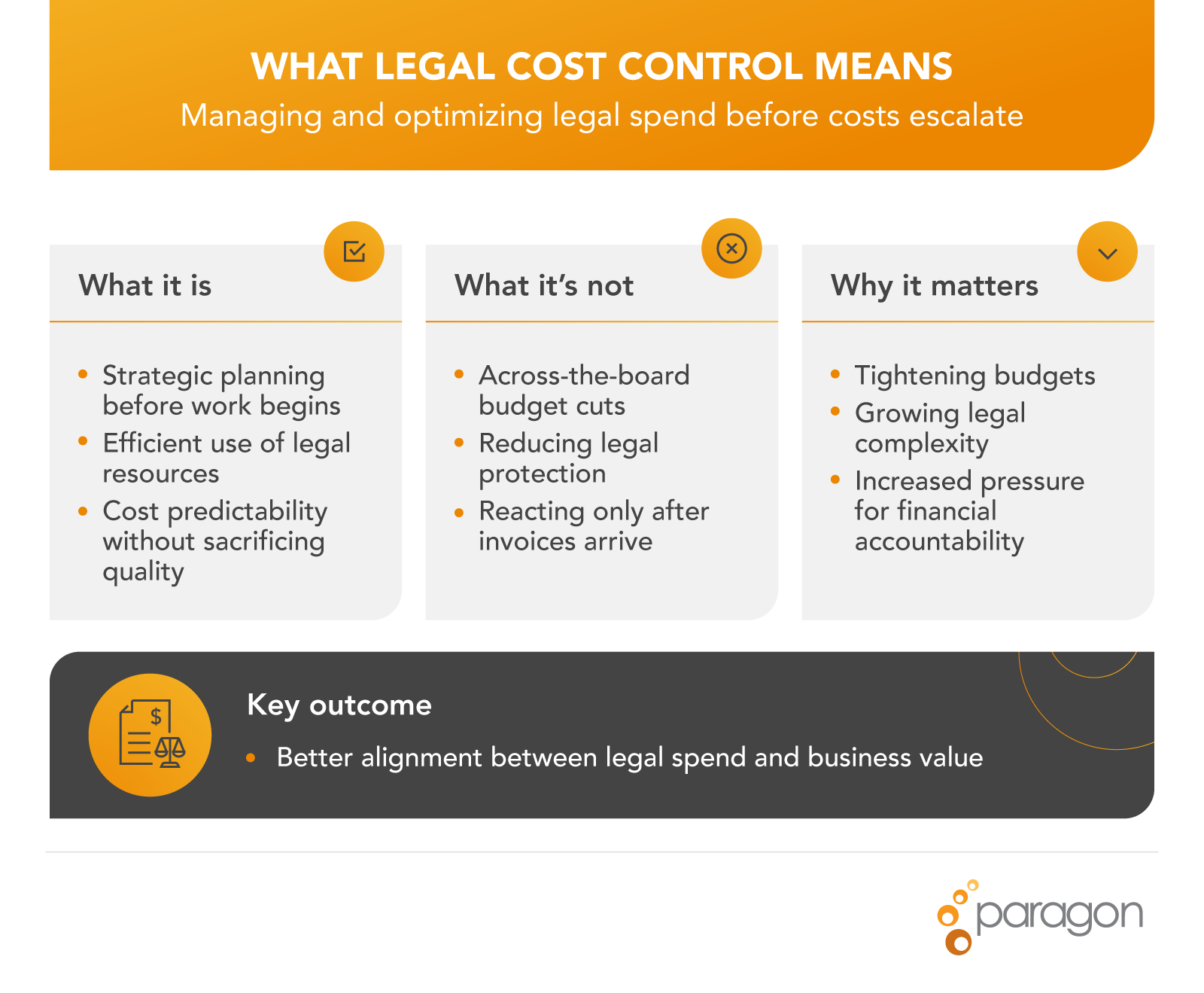
Legal cost control is the systematic approach to managing and optimizing legal expenses through strategic planning, process improvements, and smart resource allocation. It’s not simply cutting budgets or reducing quality. Cost-cutting focuses on immediate reductions, often sacrificing coverage. Legal cost management is broader, encompassing all financial oversight. Cost control sits between them, emphasizing efficiency and prevention while maintaining protection.
This article covers five proven strategies general counsel use to deliver more value from every legal dollar spent: enforcing billing guidelines, adopting alternative fee arrangements, using technology and automation, building in-house expertise, and deploying flexible legal talent strategically. Each approach helps legal departments operate more efficiently while maintaining high standards.
What Legal Cost Control Really Means (And Why It Matters Now)
Legal cost control is fundamentally about making informed decisions before legal work begins, not just reviewing invoices after the fact. The goal is predictability, efficiency, and alignment between legal spend and business value.
The core principles include:
Scope control. Define what work needs to happen and what outcomes you expect before engaging counsel or starting a project.
Resource matching. Assign work to the right level of expertise and the right billing structure based on complexity and risk.
Prevention over reaction. Invest in early legal review, standardized processes, and training to avoid costly issues downstream.
Continuous monitoring. Track spending against budgets in real time rather than discovering overruns at month-end.
Legal departments face mounting pressure to control costs while handling increased workloads. Corporate leadership expects legal teams to operate more like other business functions with clear metrics, forecasts, and accountability for financial performance.
Effective cost control improves the legal department’s credibility with finance and executive teams, frees up budget for strategic initiatives, and reduces the stress that comes from unpredictable legal spend.
The Five Rules of Legal Cost Control
These governance principles guide decision-making across all legal work, not just tactical tips:
Rule 1: Control scope before work begins. Define the problem, desired outcome, and boundaries before engaging outside counsel or assigning work internally. Unclear scope is the most common driver of budget overruns.
Rule 2: Match work to the right billing level. Not every task requires partner-level attention. Assign research, document review, and routine matters to associates, paralegals, or contract attorneys. Reserve senior counsel for strategy, negotiation, and high-stakes decisions.
Rule 3: Control pricing models, not just invoices. Choose fee structures that align with the work. Use fixed fees for routine matters, capped fees for defined projects, and hourly billing only when the scope is truly uncertain. Alternative fee arrangements shift risk and create cost predictability.
Rule 4: Enforce billing guidelines consistently. Written guidelines mean nothing without follow-through. Review invoices promptly, challenge line items that don’t comply, and address patterns with counsel directly. Consistent enforcement trains outside counsel to bill appropriately from the start.
Rule 5: Measure prevention, not just spend. Track metrics that show whether cost control efforts are working: legal issues caught early, disputes avoided, contract cycle time, and percentage of work handled in-house or through flexible staffing versus law firms. Prevention saves more than any invoice negotiation ever will.
5 Cost Control Strategies Legal Departments Use
These five approaches address different aspects of legal spending, from how you engage outside counsel to how you structure your internal team. Each strategy builds on the core principles of scope control, resource matching, and prevention-focused decision-making.
Strategy 1: Implement Rigorous Billing Guidelines and Invoice Review
Billing guidelines set expectations for how outside counsel should staff matters, bill for work, and communicate about costs. Without clear guidelines and consistent enforcement, legal departments lose control over spending.
Strong billing guidelines include:
Staffing requirements. Specify acceptable partner-to-associate ratios, prohibit unnecessary duplication, and require advance approval for staffing changes.
Billing increments and rate caps. Define how time should be billed, such as six-minute increments, and set maximum rates by role.
Expense policies. Clarify which expenses are reimbursable and which require pre-approval.
Communication standards. Require budget updates at defined intervals and immediate notice if a matter is trending over budget.
Invoice review is equally critical. Legal operations teams or designated reviewers should examine legal invoices line by line, not just check totals. Look for vague descriptions, block billing, duplicated work, and excessive time on routine tasks. This time-consuming process catches billing errors and inefficiencies that add up quickly across billable hours and legal expenses.
Enforcement matters just as much as having written guidelines. When issues arise, address them immediately with outside counsel. Persistent problems should trigger a conversation about whether the relationship is working. Law firms that know their invoices will be scrutinized bill more carefully from the start, reducing legal billing disputes and controlling costs proactively.
E-billing platforms automate compliance checks, flag guideline violations, and provide real-time visibility into spending across matters and firms. These tools make invoice review less labor-intensive while improving accuracy.
Strategy 2: Adopt Alternative Fee Arrangements for Predictable Work
Alternative fee arrangements are any pricing model other than hourly billing. These include fixed fees, capped fees, success fees, and retainer-based pricing. The goal is to align incentives, create budget certainty, and reward efficiency rather than time spent.
Alternative fee arrangements work best in specific situations:
Routine matters with a clear scope. Contract reviews, employment advice, regulatory filings, and compliance work often follow predictable patterns that make fixed pricing viable.
High-volume work. When you have multiple similar matters like trademark applications, standard NDAs, or recurring litigation, volume pricing or monthly retainers deliver significant cost savings.
Defined projects with clear endpoints. Mergers and acquisitions due diligence, policy drafting, or regulatory responses can be scoped and priced up front if expectations are clear.
Hourly billing creates several drawbacks. Hourly rates incentivize time spent rather than results achieved. They create unpredictability and require constant monitoring. For work where outcomes are more important than hours logged, alternative fee arrangements are usually more cost-effective.
Start with one practice area or matter type. Collect historical data to understand typical time and cost using benchmarks from similar matters. Propose a fee structure to your outside counsel and iterate based on results. Track whether the arrangement delivers value and adjust for future engagements.
Alternative fee arrangements require trust and clear communication. Both sides need to understand what’s included, what triggers additional fees, and how to handle scope changes. Providers and law firms that work with transparent pricing models tend to build stronger, more collaborative relationships with clients.
Strategy 3: Leverage Technology and Automation
Technology isn’t about replacing lawyers. It’s about eliminating repetitive, low-value work so legal teams can focus on judgment and strategy. Automation and purpose-built legal tools improve accuracy, speed, and cost control.
High-impact areas for legal technology include:
Contract management platforms. Centralize contract storage, automate approval workflows, and enable self-service contract creation using pre-approved templates. This reduces legal bottlenecks and outside counsel costs for routine agreements.
E-billing and spend management solutions. Track legal spend in real time, enforce billing guidelines automatically, and generate dashboards that show spending trends by matter, practice area, or law firm.
Legal research tools. Modern AI-powered research platforms reduce the time spent on case law review and regulatory analysis, cutting billable hours for research-heavy work.
Document automation. Template libraries with smart fields and conditional logic let legal teams produce consistent, compliant documents without starting from scratch each time.
Process automation extends beyond tools. Standardized workflows for intake, matter management, and approval processes streamline operations and surface cost issues earlier. When everyone follows the same process, it’s easier to identify inefficiencies and optimize resource allocation across the legal department.
Legal technology requires up-front costs and implementation effort, but the return comes quickly through reduced outside counsel fees, faster turnaround times, and better visibility into legal operations. Track metrics before and after implementation to quantify the impact and support data-driven decisions about future technology investments.
Strategy 4: Build In-House Expertise and Standardize Processes
Bringing more work in-house is one of the most effective cost control strategies when done strategically. In-house counsel costs significantly less per hour than outside counsel, and they understand your business deeply. The key is knowing which work to handle internally and building the right capabilities.
Work that’s ideal for in-house teams includes:
Ongoing advisory work. Commercial contracts, employment matters, regulatory compliance, and routine corporate governance fit naturally in-house because they require business context, and institutional knowledge is particularly helpful.
Matters requiring business judgment. In-house counsel can make risk-based decisions quickly because they understand company priorities, risk tolerance, and strategic goals.
High-volume, repeatable work. When you see the same legal issue repeatedly, whether it’s vendor contracts or employment questions, developing in-house processes and templates delivers compounding savings.
Standardization plays a critical role. Templates, playbooks, and checklists reduce decision-making time, improve consistency, and enable non-lawyers to handle routine tasks with legal oversight. Standardized workflows also make it easier to train new team members and maintain quality as workload fluctuates.
In-house teams can’t handle everything, nor should they try. The goal is to build expertise in areas that align with business needs and where internal handling delivers clear value. For specialized or infrequent work, outside counsel or flexible legal talent makes more sense as a cost-effective solution.
Training serves as a cost-control tool. When business teams understand basic legal principles like contract fundamentals, employment law basics, and compliance requirements, they make fewer mistakes and escalate issues appropriately. This prevents costly problems and reduces the volume of routine questions hitting the legal department, freeing up the function to focus on higher-value legal services.
Flexible legal staffing is a middle path between hiring full-time employees and defaulting to expensive law firms. Experienced contract attorneys and interim counsel handle defined projects, manage overflow work, and provide specialized expertise when you need it without long-term commitments.
Flexible staffing delivers the most value in these situations:
Overflow during busy periods. When your in-house team is stretched thin due to an acquisition, litigation spike, or regulatory change, flexible attorneys absorb the excess workload so your core team stays focused on strategic priorities.
Project-based work. Mergers and acquisitions due diligence, contract portfolio reviews, policy drafting, and compliance initiatives have clear start and end dates. Flexible talent scales up for the project and scales down when it’s complete.
Specialized expertise. Rather than keeping niche experts on staff or paying premium law firm rates, bring in contract attorneys with specific experience for the duration of the need.
Routine, high-volume matters. Commercial contract reviews, standard employment agreements, and compliance documentation are ideal for experienced contract attorneys who can execute efficiently at a fraction of law firm costs.
Outside counsel brings expertise but often at $500 to $1,000+ per hour, with less business context and longer ramp-up time. Full-time hires add headcount, benefits costs, and management overhead, plus you’re stuck with the cost when workload drops. Flexible legal talent sits in between: experienced, cost-effective, and scalable.
Top-tier flexible legal providers recruit senior attorneys with BigLaw and in-house experience. These aren’t junior resources or generalists. They’re specialists who choose project-based work for flexibility but deliver the same quality you’d get from a law firm at significantly lower rates, creating substantial cost savings for legal departments.
Strategic resource allocation works best when you use your in-house team for work requiring deep business knowledge and judgment, deploy flexible talent for execution-heavy projects and overflow, and reserve outside counsel for complex, high-stakes matters requiring specialized expertise or accountability.
Consider a mid-sized technology company facing an acquisition. The company could use flexible attorneys to handle all due diligence document review and integration planning, potentially paying roughly 60% less than law firm rates for the same work while freeing its in-house team to focus on deal strategy and negotiations. This hybrid approach would deliver cost savings without compromising quality or speed, optimizing the legal function’s performance.
How Legal Cost Control Lifecycle Works in Practice
Cost control is a continuous cycle, not a one-time initiative. Effective legal departments build cost consciousness into every phase of legal work.
The five phases include:
Phase 1: Plan. Before any work begins, define the scope, identify the right resources, and set clear budget expectations. Determine whether the matter should be handled in-house, by flexible talent, or by outside counsel. Agree on pricing structure and success metrics.
Phase 2: Engage. Select counsel or assign resources based on the plan. Provide context, share relevant background, and confirm that everyone understands scope, timeline, and budget. Set communication cadence for updates and escalations.
Phase 3: Monitor. Track spending against the budget throughout the engagement. Review invoices promptly. Watch for scope creep or unexpected developments that might impact cost. Use dashboards and spend management solutions to maintain real-time visibility across all matters.
Phase 4: Enforce. When issues arise like billing guidelines violations, budget overruns, or inefficient work, address them immediately. Don’t wait until the matter closes. Consistent enforcement prevents problems from recurring and signals that cost discipline matters.
Phase 5: Review. After a matter closes, evaluate what worked and what didn’t. Did the fee structure align with the work? Was the right resource assigned? What could be standardized or improved for similar future matters? Use this learning to refine your approach and optimize metrics.
This lifecycle becomes second nature with practice. Legal operations teams often manage this process, freeing general counsel and in-house attorneys to focus on substantive legal work while maintaining financial discipline across the function.
Examples of Legal Cost Control in Practice
Here are concrete examples of how legal departments apply cost control mechanisms across different practice areas:
Legal Cost Control Examples
Legal area
Cost control mechanism
How it works
Cost risk avoided
Litigation
Capped research hours per phase
Outside counsel receives fixed budget for legal research during discovery, motion practice, and trial prep
Runaway research costs and inefficient junior associate time
Commercial contracts
Fixed-fee contract reviews
Routine vendor agreements and NDAs handled at predetermined flat rate instead of hourly billing
Unpredictable hourly charges for straightforward work
Employment law
Pre-approved counsel panel
Select three employment firms with agreed-upon rates and billing guidelines for all employment matters
Rate shopping and inconsistent billing practices
Mergers and acquisitions
Flexible attorneys for due diligence
Contract attorneys handle document review and data room management while law firm leads deal strategy
Premium law firm rates for execution work
Compliance
Early legal review checkpoints
Business teams consult legal before launching products or programs, not after problems emerge
Costly remediation and regulatory penalties
Intellectual property
Volume-based trademark pricing
Bundle pricing for multiple trademark applications and renewals filed annually
Per-application premiums and administrative overhead
These mechanisms share common principles: they clarify expectations up front, match legal work to appropriate resources, and create accountability for both legal spend and outcomes. Effective cost control strategies reduce legal expenses while maintaining quality and managing risk effectively.
Where To Start: A Practical Checklist for General Counsel
General counsel and legal operations leaders can implement these actionable first steps immediately:
Review your current billing guidelines. If you don’t have written guidelines, draft them. If you have guidelines but don’t enforce them consistently, start now. Schedule quarterly reviews with your top-spending law firms to discuss compliance and expectations.
Identify your top three legal spend categories. Use historical data to determine where money goes, whether it’s outside counsel by practice area, matter types, or specific firms. Focus cost-control efforts where they’ll have the biggest impact.
Standardize fee structures for routine work. Pick one high-volume area like contract reviews, employment advice, or regulatory filings and negotiate fixed or capped fees with your outside counsel. Use the results as a model for other practice areas.
Implement an e-billing platform if you haven’t already. Real-time visibility into legal spend is foundational to cost control. Without it, you’re managing costs blindly. Modern platforms also automate guideline enforcement and provide benchmarking data.
Assess which work should move in-house or to flexible talent. Map out your legal workload and identify tasks that don’t require law firm involvement. Start with one project, perhaps due diligence support or contract portfolio review, and test whether flexible attorneys or expanded in-house capabilities deliver better value.
Create a matter budget template. Require budget estimates for every new matter or engagement. Review actuals against budget monthly. Make budget discipline part of how your legal department operates, not an occasional exercise.
Measure prevention, not just spending. Track metrics like contract cycle time, percentage of business questions resolved without outside counsel, and legal issues flagged before they become disputes. These indicators show whether your cost control strategies are creating real efficiency.
Legal cost control requires consistent attention, regular refinement, and leadership support. Start with one or two initiatives, demonstrate results, and build from there using data-driven decisions to guide your approach.
Get Control of Legal Costs Without Compromising Quality
Effective legal cost control isn’t about cutting corners or compromising quality. It’s about making strategic choices that deliver better value from every legal dollar spent. The five strategies covered here, from rigorous billing oversight to strategic deployment of flexible talent, give general counsel practical tools to manage increasing workloads within tighter budgets.
Start with one or two initiatives, measure results, and build momentum. Legal departments that embed cost discipline into daily operations don’t just save money. They earn credibility with business leaders and position themselves as strategic partners who understand both legal risk and financial responsibility.
These common questions address the practical and legal aspects of legal cost control that general counsel frequently encounter when implementing spending strategies.
What’s the difference between legal cost control and legal cost management?
Legal cost control focuses specifically on optimizing spending through strategic resource allocation, process improvements, and pricing discipline. Legal cost management is broader, encompassing all financial oversight, including budgeting, forecasting, and reporting across the entire legal function.
How much can companies typically save through effective legal cost control?
Savings vary based on current practices. Companies implementing legal spend management software can save up to 15% of total legal spend in the first year through better financial workflow automation. Additional gains come from moving routine work in-house or to flexible legal talent and adopting alternative fee arrangements for predictable matters.
Do billing guidelines damage relationships with outside counsel?
Strong law firms appreciate clear expectations and consistent enforcement. Billing guidelines improve relationships by preventing misunderstandings and ensuring both parties agree on scope, pricing, and staffing before legal work begins. Problems arise when guidelines are vague, inconsistently applied, or unreasonable.
When should companies use law firms versus flexible legal talent?
Use law firms for complex matters requiring specialized expertise, significant judgment, or formal accountability, including high-stakes litigation, novel regulatory issues, or strategic transactions. Deploy flexible legal talent for execution-heavy work, project-based needs, and routine matters where experience matters more than specialized expertise.
How do you measure whether legal cost control efforts are working?
Track both lagging indicators like total legal spend, average hourly rates, and cost per matter, and leading indicators like percentage of work on alternative fee arrangements, in-house resolution rates, and early issue escalation metrics. The combination shows whether you’re reducing legal costs and improving efficiency.
We may request cookies to be set on your device. We use cookies to let us know when you visit our websites, how you interact with us, to enrich your user experience, and to customize your relationship with our website.
Click on the different category headings to find out more. You can also change some of your preferences. Note that blocking some types of cookies may impact your experience on our websites and the services we are able to offer.
Essential Website Cookies
These cookies are strictly necessary to provide you with services available through our website and to use some of its features.
Because these cookies are strictly necessary to deliver the website, refusing them will have impact how our site functions. You always can block or delete cookies by changing your browser settings and force blocking all cookies on this website. But this will always prompt you to accept/refuse cookies when revisiting our site.
We fully respect if you want to refuse cookies but to avoid asking you again and again kindly allow us to store a cookie for that. You are free to opt out any time or opt in for other cookies to get a better experience. If you refuse cookies we will remove all set cookies in our domain.
We provide you with a list of stored cookies on your computer in our domain so you can check what we stored. Due to security reasons we are not able to show or modify cookies from other domains. You can check these in your browser security settings.
Other external services
We also use different external services like Google Webfonts, Google Maps, and external Video providers. Since these providers may collect personal data like your IP address we allow you to block them here. Please be aware that this might heavily reduce the functionality and appearance of our site. Changes will take effect once you reload the page.
Google Webfont Settings:
Google Map Settings:
Google reCaptcha Settings:
Vimeo and Youtube video embeds:
Privacy Policy
You can read about our cookies and privacy settings in detail on our Privacy Policy Page.




 Employee Portal
 Apply
Apply