85% of corporate law departments use law firms, which means portfolio resourcing (a strategic mix of FTEs, outside counsel, and ALSPs) is already the default for most legal departments.
57% of corporate law departments use ALSPs, which signals that flexible models are now mainstream, not a workaround.
71% of legal leaders plan to hire contract or temporary talent in the first half of 2026, which puts flexible resourcing on the near-term roadmap for many legal operations teams.
In-house legal teams are dealing with a familiar mix of increased demand from business units, tighter budgets, and constant workload swings. The answer is rarely “hire more” or “send it all to law firms.” It is building a repeatable legal resourcing strategy that matches legal matters to the right delivery model.
That usually means a mix of full-time employees (FTE) on your in-house team for core, day-to-day work; outside counsel for high-stakes judgment, specialized expertise, and accountability; and flexible counsel (experienced legal professionals brought in on an interim basis) to add capacity without adding permanent headcount.
This article gives general counsel, chief legal officers, and legal operations leaders a clear framework for making staffing decisions, plus comparison tables you can use in planning conversations with the C-suite and stakeholders. You will also see examples of how flexible counsel can relieve contract backlog and stabilize workflows.
Why Legal Resourcing Strategy Matters in 2026
Outside counsel remains essential for high-stakes matters, but rising rates are prompting legal departments to be more deliberate about when to engage them. Thomson Reuters reported that Am Law 100 standard rates crossed the $1,000 mark in 2025, while other segments averaged around $600. This increases pressure on legal departments to reserve premium firms for the work that truly needs them.
At the same time, flexible models are no longer niche. The 2025 Thomson Reuters ALSP report found that 57% of corporate law departments use ALSPs, and that category includes flexible talent solutions like counsel and paralegals. In addition, 71% of legal leaders plan to hire contract or temporary talent in the first half of 2026, signaling that flexible resourcing is moving from optional to expected in modern corporate legal team structure planning.
Legal Resource Decision Framework
A strong legal resourcing strategy starts with one principle: Select the resource that fits the work. Corporate law departments make this call using factors like cost, business familiarity, specialized expertise, bandwidth, speed, and efficiency.
Decision Criteria
Use these criteria to decide between FTEs, law firms, and flexible counsel:
Matter risk and accountability requirements
Urgency and turnaround time expectations from business units
Repeatability and availability of templates, playbooks, and workflow maturity
Need for institutional knowledge, legal advice, and tight integration into the in-house legal function
Depth of specialized expertise required, including intellectual property, real estate, or regulatory
Volume and volatility, including quarter-end pushes, product launches, or M&A peaks
Management overhead, including training, supervision, and stakeholder alignment
Budget predictability, including the ability to forecast spend and track metrics and KPIs
Decision Framework
Decision factor
Best fit: FTE
Best fit: Law firm
Best fit: Flexible counsel
Risk level
Ongoing, medium-risk matters with strong business context required
High-risk matters needing formal sign-off and credibility
Medium risk execution work with defined scope
Speed needs
Fast once processes exist and bandwidth is stable
Fast for complex strategy if prioritized, slower for routine work
Fast ramp for defined work during peaks
Expertise
Company-specific knowledge, generalist coverage
Deep specialization and senior judgment
Specialized expertise on demand, without a permanent hire
Integration
Highest, full systems and workflow ownership
Lowest, external counsel with limited systems access
High, embedded with the in-house team structure
Cost predictability
Predictable over time, higher fixed cost
Variable, can spike with scope creep
Flexible cost model based on scope and workload
Request a talent consultation to map your decision framework to your legal department structure.
When To Use FTEs
Here’s a breakdown of when full-time employees make the most sense, and where they can create strain.
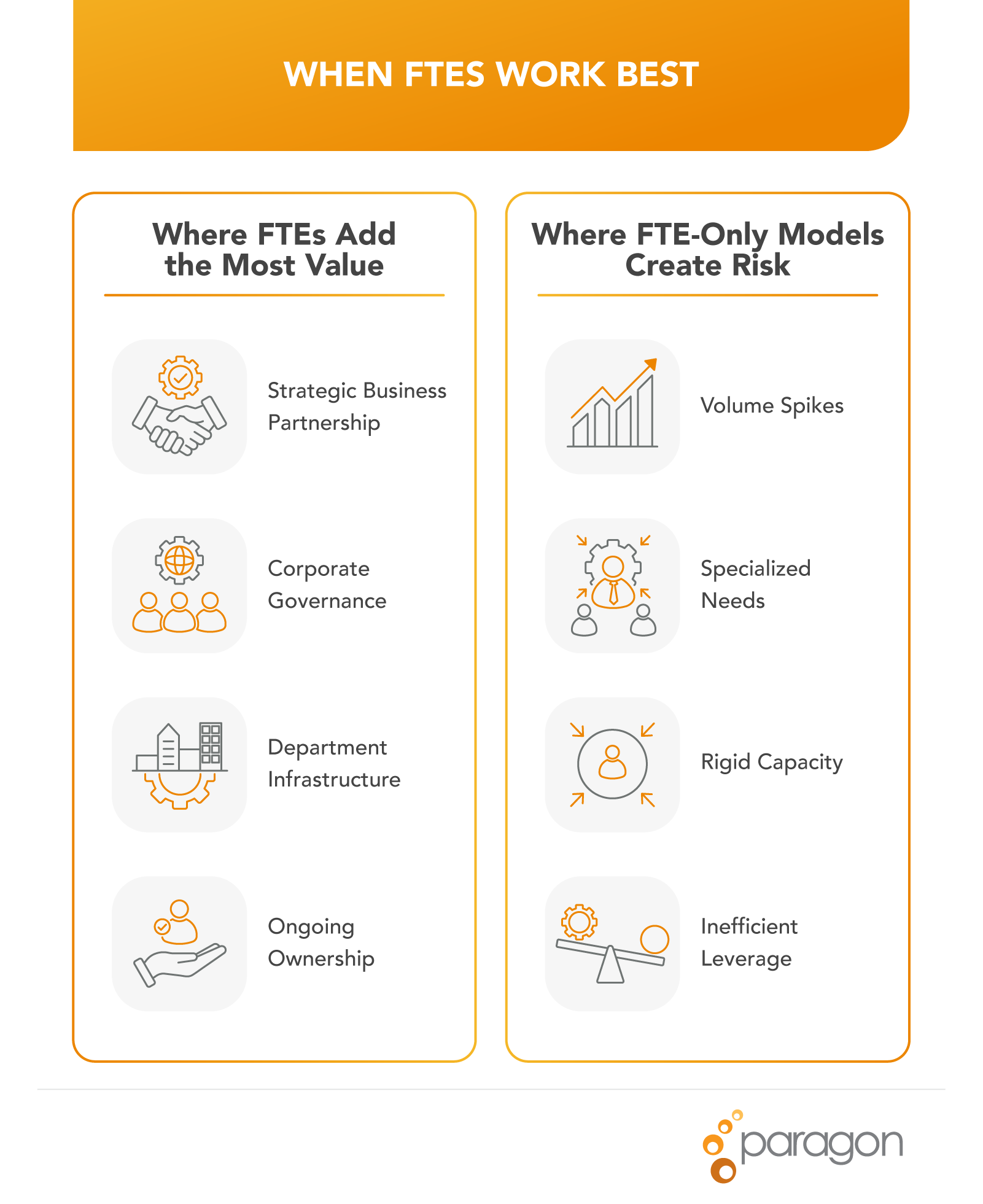
Where FTEs Add The Most Value
FTEs make sense when legal work requires deep business context, consistent ownership, and close collaboration with stakeholders. They work best in roles that shape how the legal function operates over time.
This typically includes:
Strategic business partnership. Advising business units on risk, tradeoffs, and long-term planning.
Department infrastructure. Building templates, intake workflows, and decision-making norms that define how the in-house legal team operates.
Ongoing ownership. Managing programs or areas of law that require continuity and institutional knowledge.
When the work is embedded, recurring, and closely tied to company strategy, FTEs provide stability and accountability.
Where FTE-Only Models Create Risk
An FTE-only model can struggle when legal demand fluctuates or priorities shift quickly. Even strong legal departments can experience bottlenecks under pressure.
Common friction points include:
Volume spikes. Contract backlogs build when demand outpaces internal capacity.
Specialized needs. Senior counsel handles work that could be delegated or that requires niche expertise not available in-house.
Rigid capacity. Headcount is slow to adjust when the business scales up or down, or when contract volume spikes.
Inefficient leverage. High-cost talent spends time on lower-complexity work due to limited team structure or workflow design.
When workload becomes unpredictable, teams often need flexibility in addition to full-time talent.
When To Use Law Firms
According to Thomson Reuters, 85% of corporate law departments use law firms. There are different criteria for going with a law firm. They are typically best suited for work where senior judgment and credibility matter most. That includes bet-the-company disputes, specialized regulatory matters, and major transactions where a firm’s experience and ability to stand behind strategy is part of the value.
If M&A resourcing comes up, keep the hybrid model clear: Law firms shape deal risk and strategy, in-house teams stay aligned with business goals and make final decisions, and interim counsel support execution once strategy is set.
When To Use Flexible Counsel
Finally, there are a few things to consider when bringing on flexible counsel. Flexible counsel is appropriate when the work should sit close to the in-house legal team, but the legal department lacks the bandwidth or the exact skill set internally. This includes contract overflow, commercial support during peak periods, diligence support, playbook and template refreshes, document management cleanup, and time-bound practice area needs.
Trista Engel, CEO of Paragon Legal, describes the model this way: “Flex talent is brought in when you would typically do the work in-house, but don’t have the bandwidth.”
Deal structuring, lead negotiations, unusual risk allocation
Policy and template work
Updating templates, building playbooks, triage workflows
Novel issues requiring new legal positions at high risk
Regulatory and compliance support
Program execution, documentation, tracking, project management
Complex, heavily regulated, or high-exposure strategy calls
Litigation support
Discovery support and workflow-heavy tasks
Core litigation strategy and formal sign-offs
Case Examples
The examples below show common situations where flexible counsel supports an in-house legal team without adding permanent headcount. Each scenario is generalized to protect confidentiality while highlighting the staffing choice and the outcome.
Contract Backlog Relief A corporate legal department faced a sustained contract backlog that slowed sales and vendor onboarding. Instead of shifting routine contracts to a law firm, team members embedded flexible counsel to triage intake and handle redlines. The result was faster turnaround times, fewer escalations to senior counsel, and a steadier workflow for business units.
Special Project Surge A legal operations team needed to modernize document management and standardize templates across practice areas, but could not justify a permanent hire. A flexible legal operations resource ran a time-bound project, built an intake workflow, updated templates, and set metrics for cycle time and backlog tracking.
Peak Period Coverage During quarter-end and seasonal peaks, the legal function needed additional coverage for routine reviews and internal coordination. Flexible support helped keep contract and marketing review queues moving, which reduced emergency outside counsel spend and protected the core team from burnout.
How To Operationalize the Strategy in Your Legal Department
Once you choose the right mix of FTEs, law firms, and flexible counsel, the next step is building simple processes and metrics that keep the legal function running smoothly as demand changes.
Metrics To Track
Pick a small set of legal operations metrics that reflect speed, cost, and stakeholder outcomes:
Turnaround time. Time from intake to first legal touch, then to signature.
Backlog volume. Open matters by type and age.
Outside counsel spend. Spend by matter category, with budget variance.
Cost per matter type. Fully loaded cost for repeat work categories.
Internal client satisfaction. Lightweight pulse checks with business units.
Process Assets To Build
Create and optimize assets that take disruption out of staffing changes:
Templates and playbooks. Standard language, positions, and approval paths.
Intake and triage workflow. Clear rules for routing to in-house counsel, flexible counsel, or outside counsel.
Onboarding guide. Risk tolerance, systems access, escalation paths, and “how work moves.”
Reporting cadence. Monthly dashboards for the C-suite and finance partners.
Your Next Step: Put the Framework To Work
A modern legal resourcing strategy is a portfolio. FTEs provide continuity and business context, law firms bring senior judgment and accountability for high-stakes matters, and flexible counsel adds capacity and specialized execution when the in-house legal team needs to move quickly. With 57% of corporate law departments using ALSPs, and 71% of legal leaders planning to hire contract talent in early 2026, the flexible layer is increasingly part of standard legal department planning.
If you want a practical next step, start with the strategic decision framework and the comparison tables in this article, then map your top matter types to a staffing approach you can justify with metrics.
Paragon Legal is standing by to help. Request a legal professional and get the support your team needs to succeed.







 Employee Portal
 Apply
Apply