Legal search interest is rising nationwide, but the pace and areas of interest vary considerably by specialty. We analyzed monthly U.S. search volume for legal keywords across all 50 states from July 2022 through June 2026, grouping keywords into practice areas to identify where interest was concentrated and where it was growing.
For legal leaders managing changing workloads and specialized talent needs, these patterns offer a view into the areas where interest may be shifting fastest and underscore the value of building a resourcing model that can adapt as needs change.
Key Takeaways
AI and emerging tech accounted for 21% of search interest across the 11 legal specialties analyzed, one of the largest shares of any specialty.
Search interest in AI and emerging tech legal services grew 685% over three years, the steepest rise of the 11 specialties analyzed.
Legal search interest grew in all 50 states, with a national median increase of 144%. Ohio, Indiana, and Pennsylvania each more than tripled.
Lawyer employment is projected to grow 5% over the next decade, which is faster than the 3% average for all occupations.
Search Interest Is Concentrated in a Few Legal Specialties
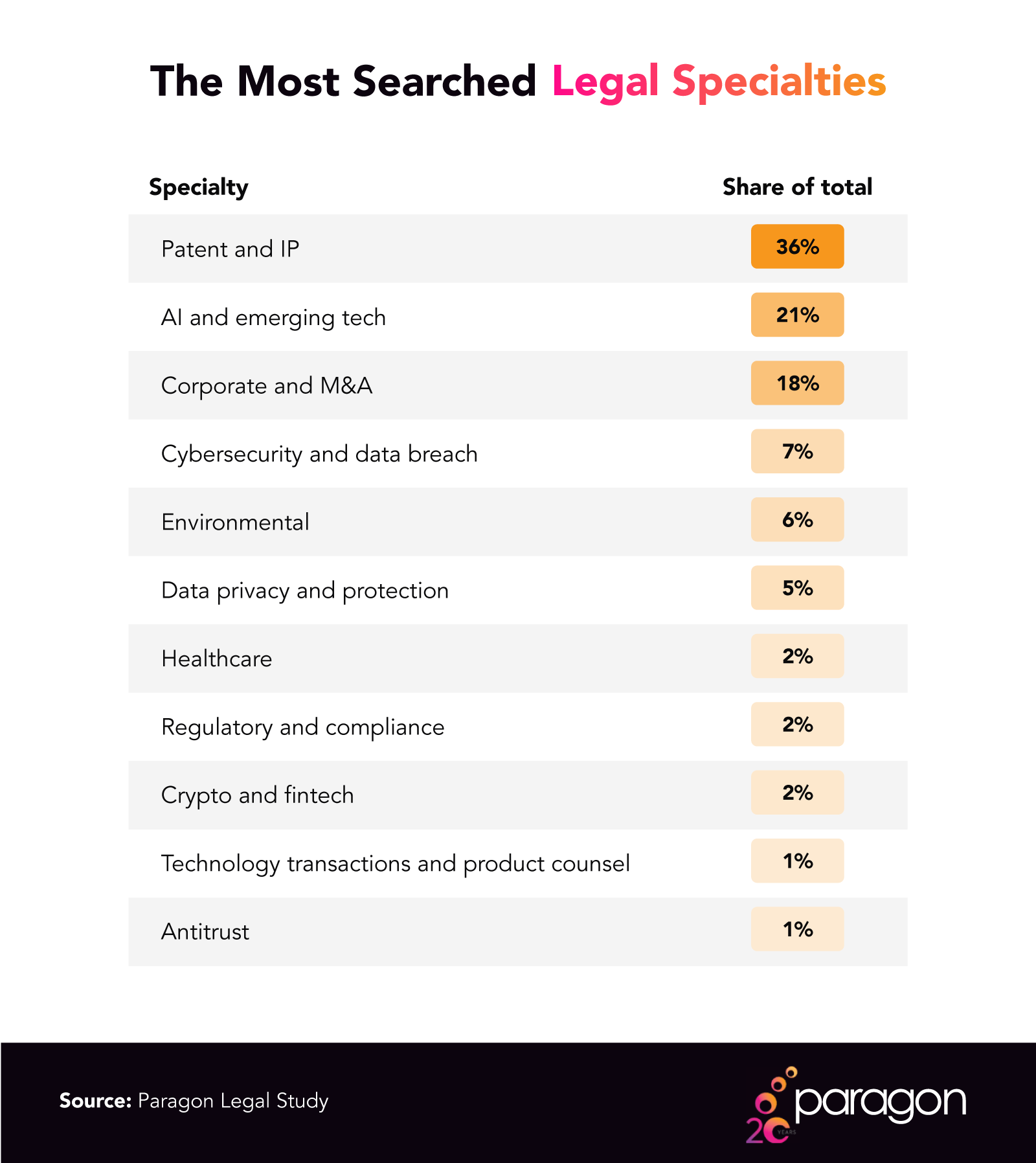
Search volume was far from evenly distributed across practice areas. Three specialties accounted for roughly three quarters of all activity, while the remaining eight together made up the rest. These are the 11 specialties analyzed, ranked by total search volume over the period.
Patent and IP accounted for the largest share of search interest at 36% of the total. AI and emerging tech ranked second at 21%, ahead of corporate and M&A at 18%, making emerging technology a substantial part of the legal search market.
Data privacy and cybersecurity appear as separate specialties here, grouped by whether the search terms related to privacy and data protection or to security and breach response. The two grew at different rates over the period.
Emerging Technology Leads Growth in Legal Search Interest
The specialties attracting the most interest today are only one part of the picture. Growth rates provide another signal of the areas attracting rapidly increasing attention.
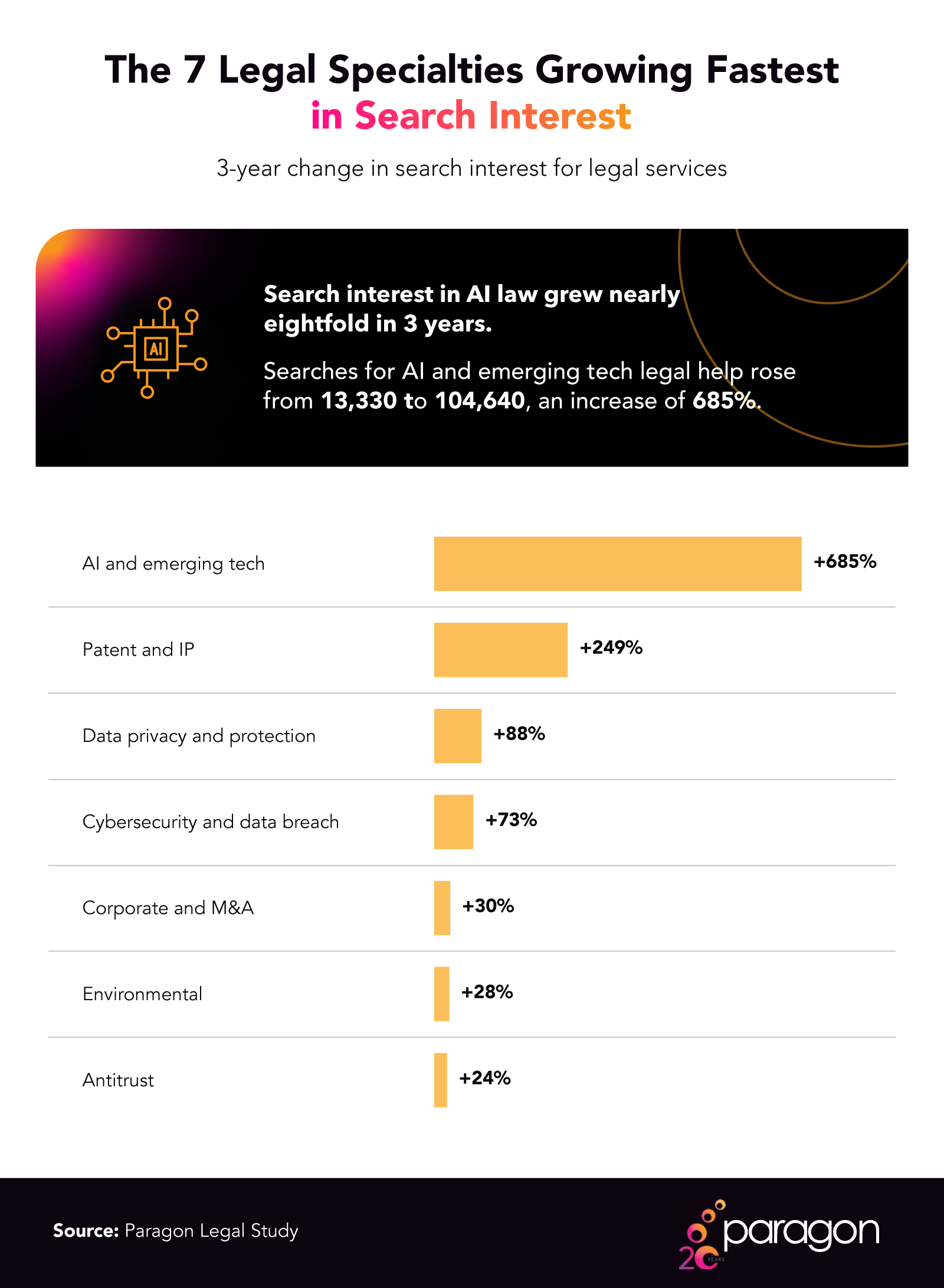
Of the 11 specialties analyzed, these seven grew fastest. AI and emerging tech led at 685%, while patent and IP followed at 249%.
Four specialties are not shown: crypto and fintech, healthcare, regulatory and compliance, and technology transactions and product counsel. Each accounted for a small share of overall search interest, and their changes over the period were too small to read as a trend.
The scale of AI and emerging tech growth was particularly notable alongside its overall search volume. The specialty was already the second most searched among those analyzed, suggesting that its rapid growth stemmed from a meaningful base of interest rather than from a small, niche category.
Search interest reflects what people are looking up online. It may lead, lag, or diverge from actual legal work volumes, so these figures indicate where attention is shifting rather than where legal services are being purchased.
Rapidly changing areas of legal work can create a workforce-planning challenge. Legal departments may need access to new capabilities before they know whether those needs will become long-term or how much ongoing capacity they will require. Flexible legal talent gives leaders a way to bring in experienced specialists when and where they’re needed while preserving the ability to adjust the team’s resourcing mix as business needs evolve.
Search Interest Grew in Every State
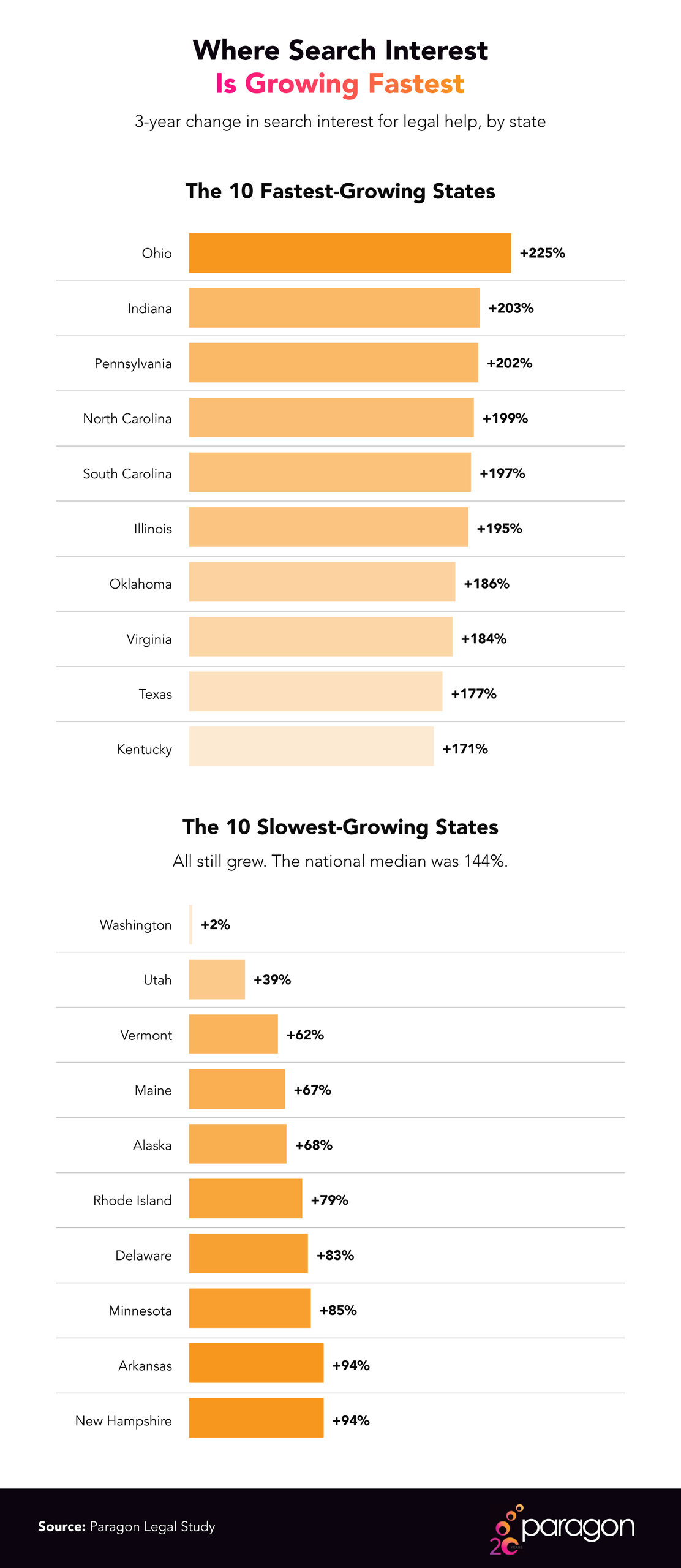
Search interest also increased geographically, rising across all 50 states over the period analyzed.
Legal search interest grew across all 50 states, with a national median increase of 144%. Growth was strongest in Ohio, Indiana, and Pennsylvania, each of which more than tripled over the period, while Washington grew 2%.
Legal Employment Is Growing as Areas of Interest Shift
Search interest is only one side of the picture. Federal labor projections show what is happening to the profession itself.
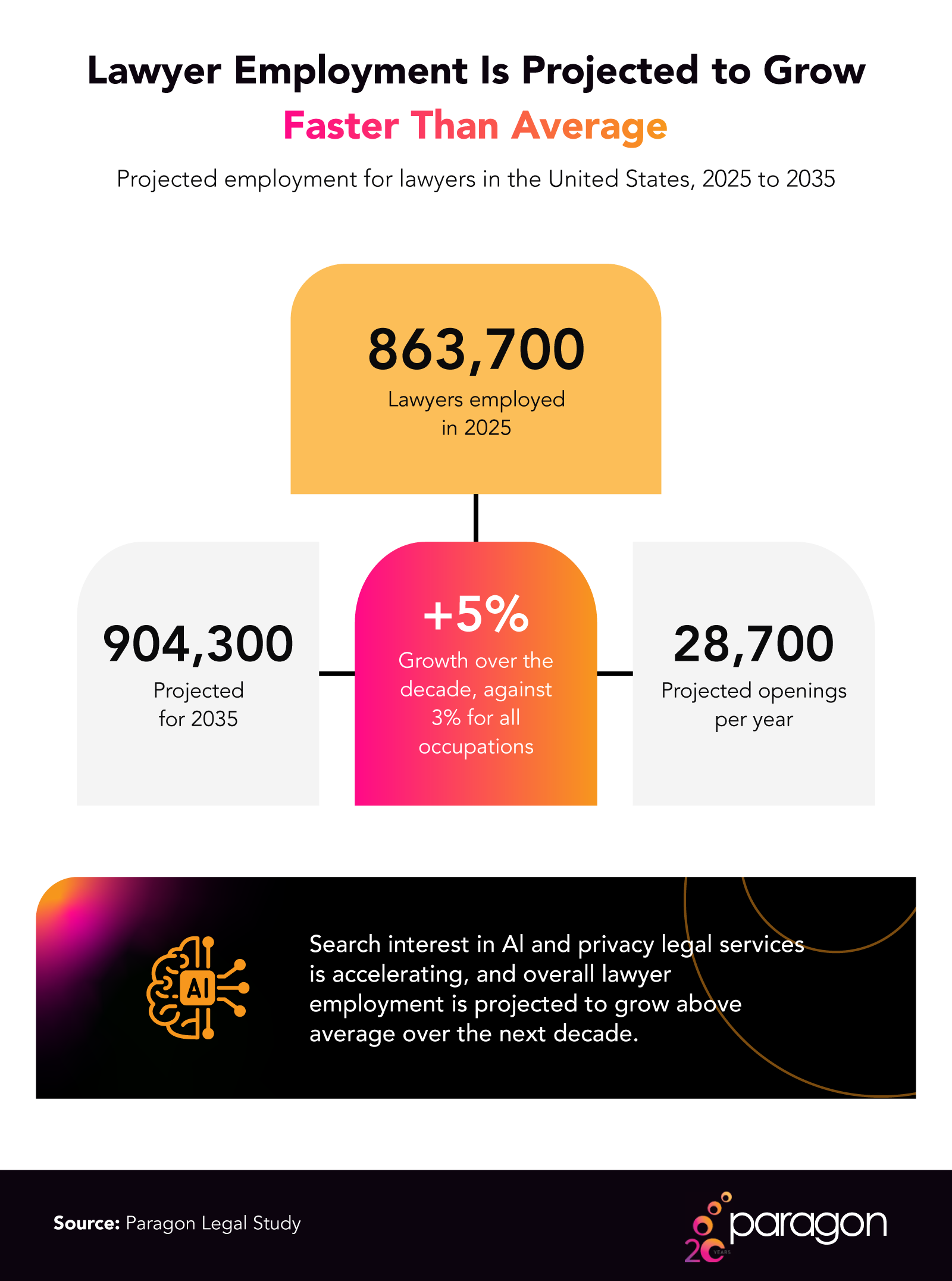
The U.S. Bureau of Labor Statistics projects employment of lawyers to grow 5% between 2025 and 2035, faster than the 3% projected for all occupations. That represents roughly 40,600 additional positions over the decade, with about 28,700 openings expected each year on average.
Search interest in AI and privacy legal services is accelerating, and the profession is expanding at an above-average rate. What the two datasets together suggest is that interest is concentrating into a small number of fast-growing specialties, while the profession as a whole grows steadily.
Most of those projected openings are also expected to come from replacing lawyers who retire or move into other work, rather than from newly created positions. For legal departments, that points less toward a hiring problem than toward a planning one. The specialties drawing the most attention today may not be the ones drawing it in five years. For legal departments, that makes it increasingly important to distinguish between capabilities that belong on the core team and emerging or variable needs that may be better served through flexible expertise.
Preparing for Shifting Legal Needs
Legal search interest grew across every state analyzed, but it did not move evenly across specialties. AI and emerging tech posted the fastest growth and already ranked second in overall search volume, while patent and IP drew the largest share of interest overall. Federal projections show the profession expanding at an above-average rate over the coming decade, even as interest concentrates into a narrower set of specialties.
The larger takeaway isn’t that legal departments should try to predict exactly where the next area of demand will emerge. It’s that their resourcing models need to be able to adapt when it does. Building flexible access to experienced legal talent can help departments respond to emerging specialties, changing workloads, and evolving business priorities without assuming today’s mix of needs will look the same tomorrow.
Methodology
We analyzed monthly U.S. search volume for legal keywords across all 50 states and the District of Columbia, covering July 2022 through June 2026. The District of Columbia is excluded from state comparisons, as it is a city rather than a state.
The study covered 11 practice areas built from 34 search terms: AI and emerging tech, antitrust, corporate and M&A, crypto and fintech, cybersecurity and data breach, data privacy and protection, environmental, healthcare, patent and IP, regulatory and compliance, and technology transactions and product counsel. The analysis did not evaluate several other significant areas of legal work, including employment and labor, litigation, tax, immigration, and insurance. The generic terms “cybersecurity” and “data privacy” were also excluded, as they measure topic interest rather than interest in legal help.
Unusual one-month volume spikes were capped so they would not distort three-year comparisons.
Growth figures compare the same six calendar months three years apart, July through December 2022 against July through December 2025, holding seasonality constant.
Employment projections come from the U.S. Bureau of Labor Statistics Occupational Outlook Handbook, using the 2025 to 2035 projections cycle. BLS classifies lawyers as a single occupation and does not break employment out by practice area, so those figures describe the profession as a whole rather than any individual specialty.
Search interest reflects what people are looking up online. It may lead, lag, or diverge from actual legal work volumes, so these figures indicate where attention is shifting rather than where legal services are being purchased.
About Paragon Legal
Paragon Legal is on a mission to make in-house legal practice a better experience for everyone. We provide legal departments at leading corporations with high-quality, flexible legal talent to help them meet their changing workload demands. At the same time, we offer talented attorneys and other legal professionals a way to practice law outside the traditional career path, empowering them to achieve both their professional and personal goals.
Fair Use Statement
The information in this article may be shared for noncommercial purposes only. When sharing these findings, please provide proper attribution and a link to Paragon Legal.





 Employee Portal
 Apply