The contract attorney market is in the middle of a meaningful shift. AI is accelerating the value of specialized legal expertise, and flexible work is moving from a niche arrangement to a core part of how legal teams operate.
For contract attorneys who can combine deep practice area knowledge with the ability to use new tools and manage complex work, this is a moment of real opportunity. Paragon Legal surveyed 163 attorneys and hiring managers to understand where the market stands in 2026 and where it’s headed.
Key Takeaways
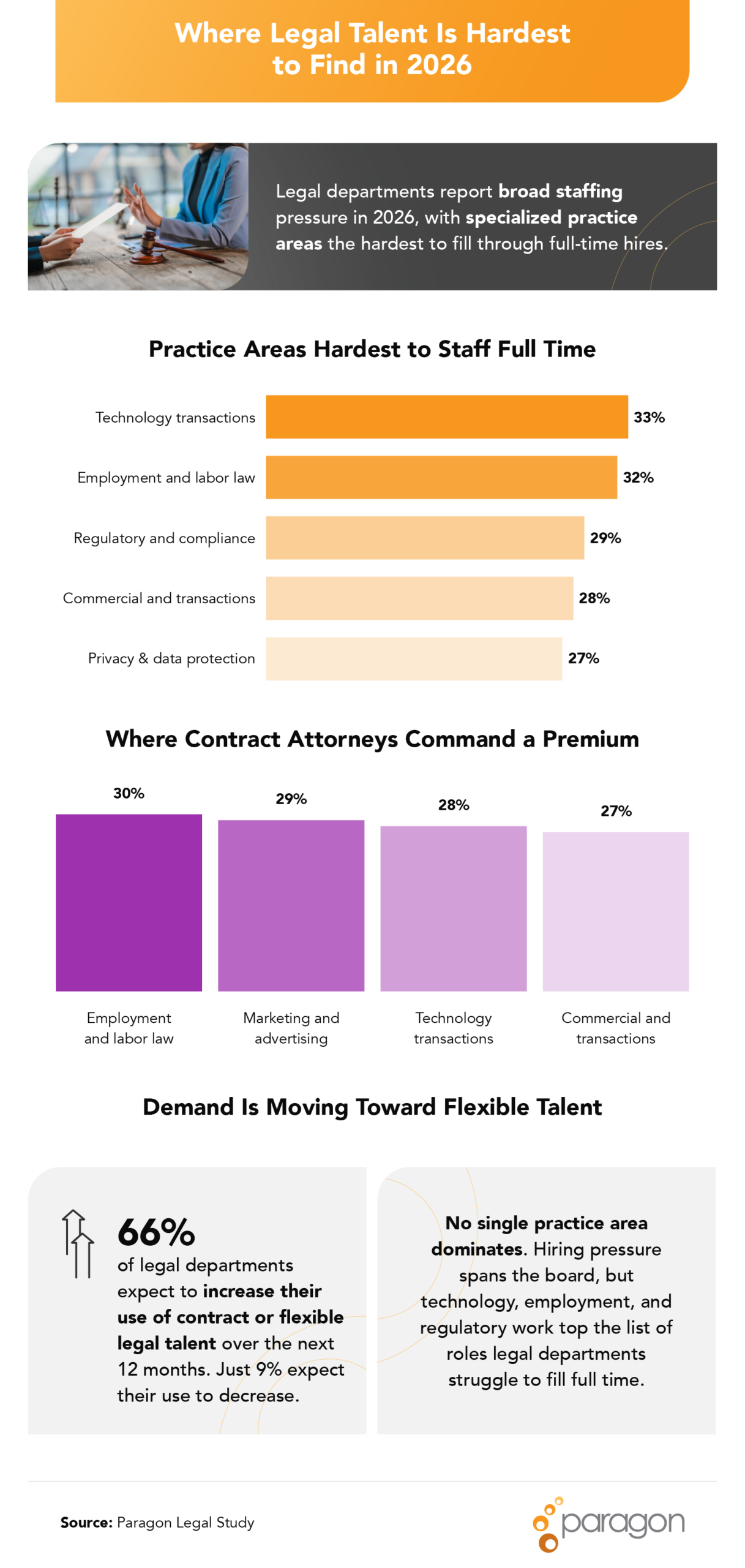
Specialized legal talent is scarce, with technology transactions (33%), employment and labor law (32%), and regulatory and compliance (29%) the hardest practice areas to fill through full-time hires.
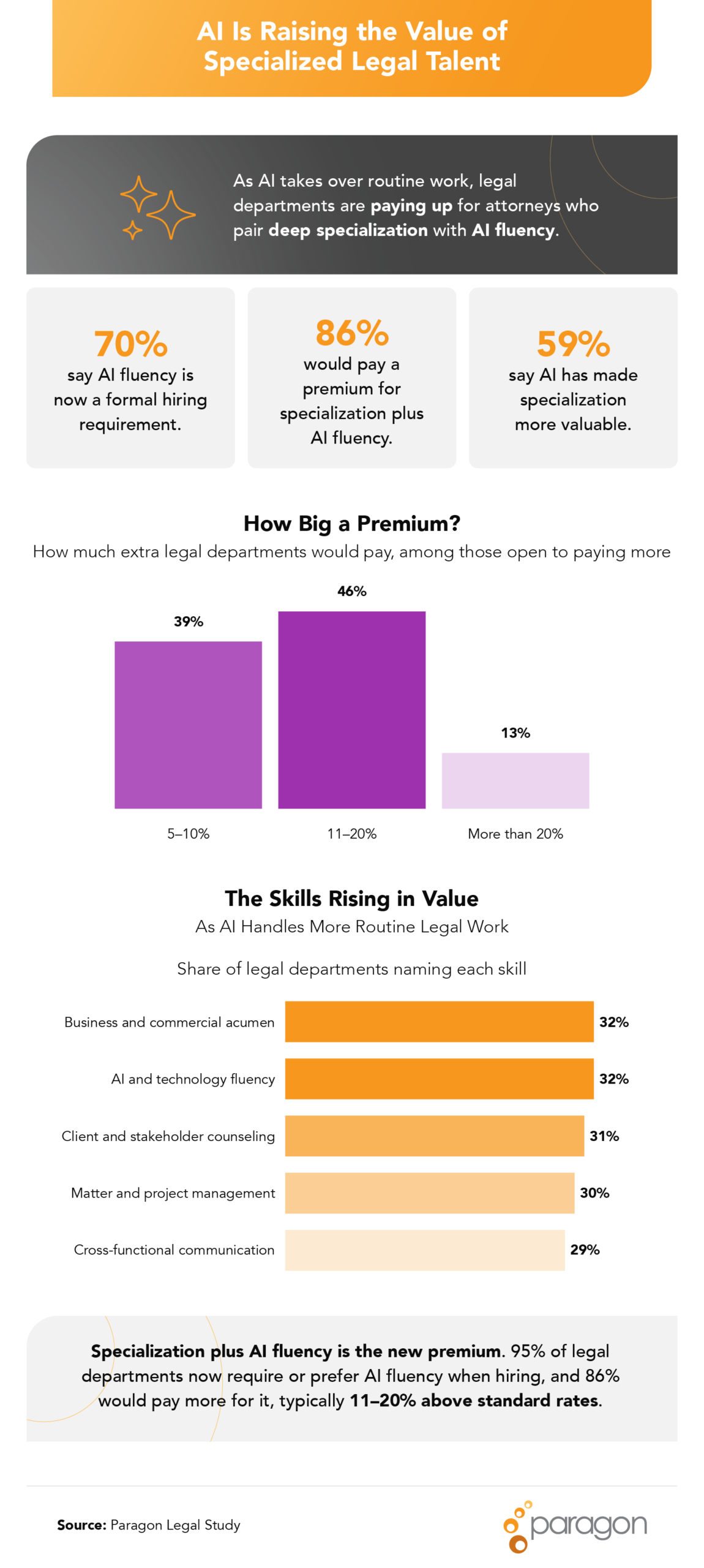
86% of legal departments would pay a premium for contract talent that pairs specialization with AI fluency, typically 11 to 20% above standard rates.
AI fluency has become a baseline hiring expectation, treated as a formal requirement by 70% of legal departments and required or preferred by 95%.
Two-thirds of legal departments (66%) expect to increase their use of contract or flexible talent over the next year.
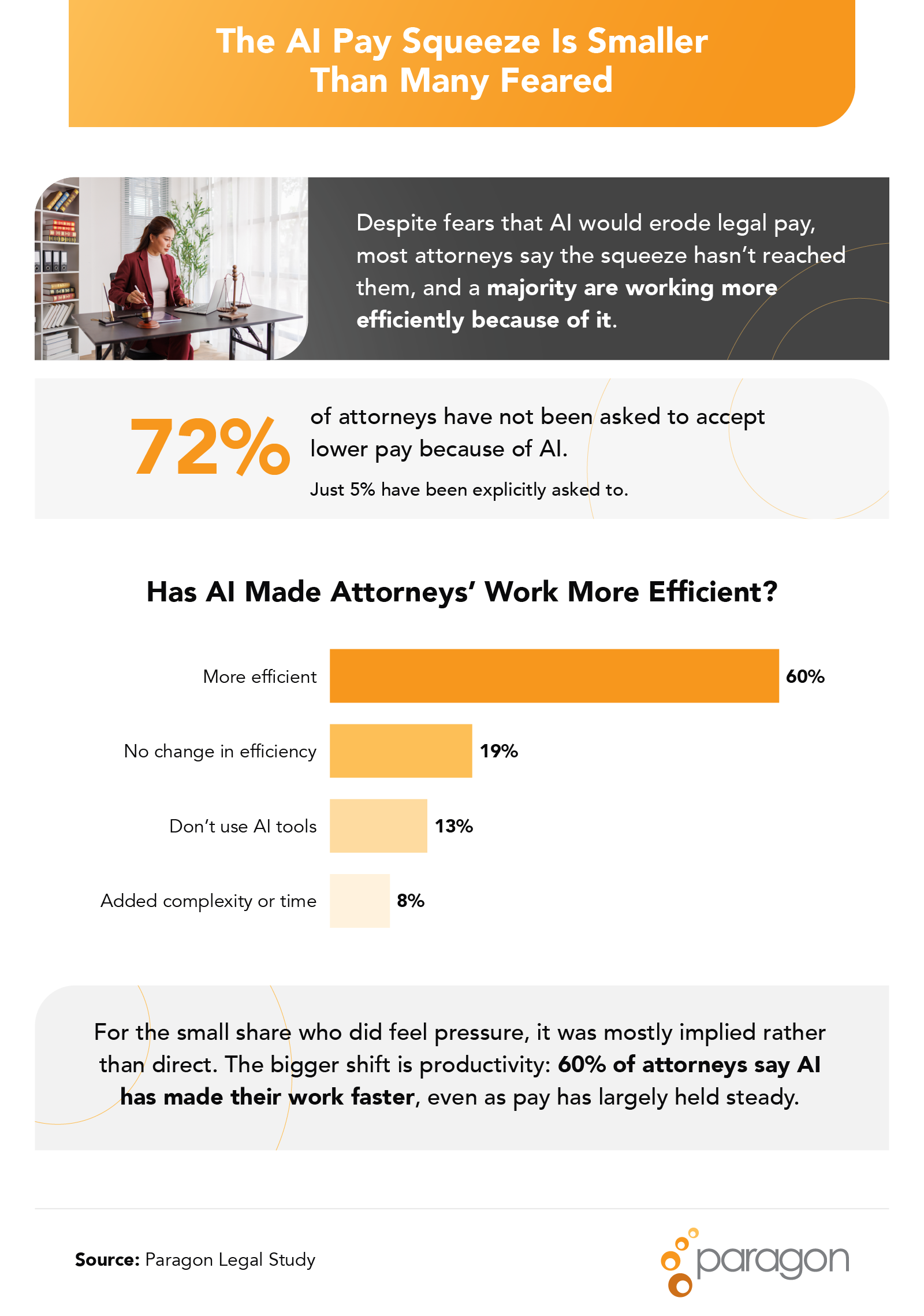
Most attorneys (72%) have not faced AI pay pressure, and 60% say AI has made them more efficient.
Specialized Legal Talent Is Getting Harder to Find
Legal departments are finding it hard to fill specialized work through full-time hires, and the squeeze runs across nearly every practice area.
Technology transactions top the list of hard-to-staff areas (33%), followed by employment and labor law (32%), regulatory and compliance (29%), commercial and transactions (28%), and privacy and data protection (27%).
Contract attorneys most often command a premium in employment and labor law (30%), marketing and advertising (29%), technology transactions (28%), and commercial work (27%).
Two-thirds of legal departments (66%) expect to increase their use of contract or flexible talent over the next year, compared with just 9% planning to cut back.
AI Is Changing Legal Work, and That’s an Opportunity for Contract Attorneys
As AI absorbs routine work, legal departments are paying more for attorneys who pair deep specialization with the ability to use new tools well.
Most legal departments (70%) say AI fluency has become a formal hiring requirement, and nearly all of the rest prefer it, putting the combined share at 95%.
More than eight in 10 (86%) say they would pay a premium for contract talent that pairs specialization with AI fluency, most often 11 to 20% above standard rates.
A majority (59%) say AI has made specialization more valuable, and the skills they prize most include business and commercial acumen (32%) and AI and technology fluency (32%).
“AI is increasing the leverage and value of experienced attorneys, not replacing them. It handles routine tasks so you can focus on the work that requires your judgment and expertise. The attorneys who will be most valuable are the ones who can pair AI with deep specialization.
The market is still adjusting its compensation models to reflect that, but the direction is clear. Specialized attorneys who know how to use AI effectively are going to be in the highest demand.”
— Trista Engel, CEO, Paragon Legal
The AI Pay Squeeze Is Smaller Than Many Feared
The fear that AI would erode attorney pay has not played out for most of the profession. Where AI has changed the job, it has changed how attorneys work more than what they earn.
Nearly three-quarters of attorneys (72%) say they have not been asked to accept lower pay because of AI, and only 5% have been asked to do so outright.
A majority (60%) say AI has made their work more efficient, compared with just 8% who say the tools added complexity or time.
Among the small share who did feel pressure, most describe it as implied rather than stated directly, which is a sign the market has not broadly repriced legal work around AI.
Is Flexible Work Here to Stay?
Flexible work is settling in as a lasting feature of legal practice rather than a temporary arrangement, and full-time and contract attorneys see it much the same way.
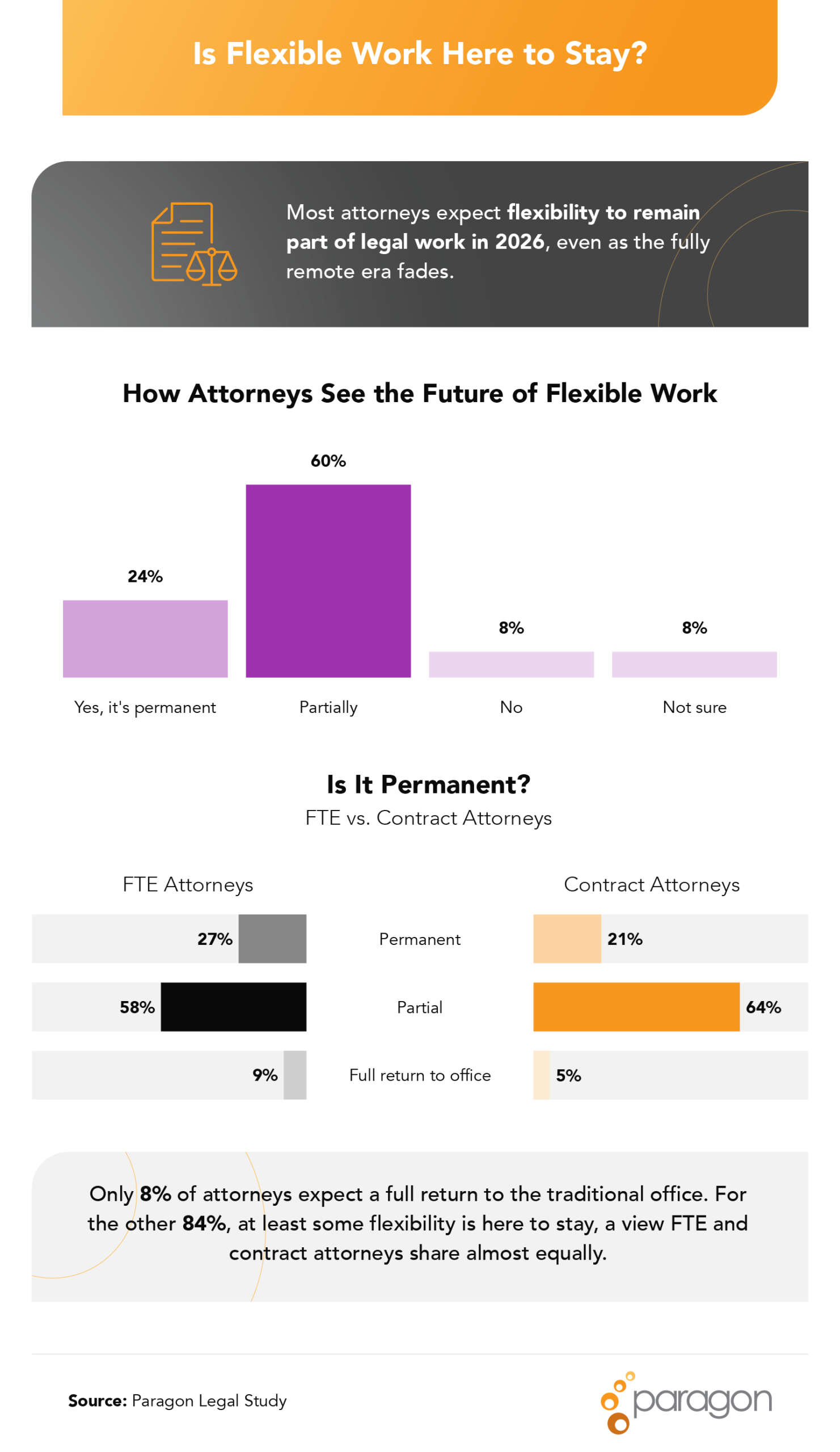
Most attorneys (84%) expect at least some flexibility to remain, with 24% calling it permanent and only 8% anticipating a full return to the traditional office.
Full-time attorneys are slightly more likely to call flexibility permanent (27%) than contract attorneys (21%), though both groups land near 85% expecting it to continue in some form.
Only 9% of full-time attorneys and 5% of contract attorneys expect a full return to in-office work.
Methodology
Paragon Legal surveyed 163 attorneys and hiring managers in the legal industry to explore how pay for contract attorneys may be changing. Respondents were asked about the impact of AI, if any, on efficiency and pay. This survey sample contains 39 contract attorneys and 17 hiring managers who specifically hire contract attorneys. We also surveyed 93 full-time attorneys and 14 hiring managers who specifically recruit full-time attorneys. Responses were collected from April 13, 2026, to April 16, 2026.
We surveyed an additional 275 legal hiring decision-makers to explore how legal departments staff their teams and where they see specialized talent as scarce or worth a premium. Respondents were asked about the practice areas hardest to fill through full-time hires, where contract attorneys command a premium, and the value of AI fluency in legal talent. This survey sample contains 237 in-house legal leaders, in roles such as general counsel, deputy general counsel, and head of legal operations. Responses were collected from June 24, 2026, to June 25, 2026.
About Paragon Legal
Paragon Legal connects companies with experienced contract attorneys for flexible, high-quality legal support. Paragon works to match attorneys with opportunities that reflect their expertise and deliver fair compensation. Learn more about how Paragon Legal can support your legal career or staffing needs.
Fair Use Statement
This research and its findings may be freely used, referenced, or republished for non-commercial purposes. If you use this data, please credit Paragon Legal and link back to this page as the original source.





 Employee Portal
 Apply
Apply