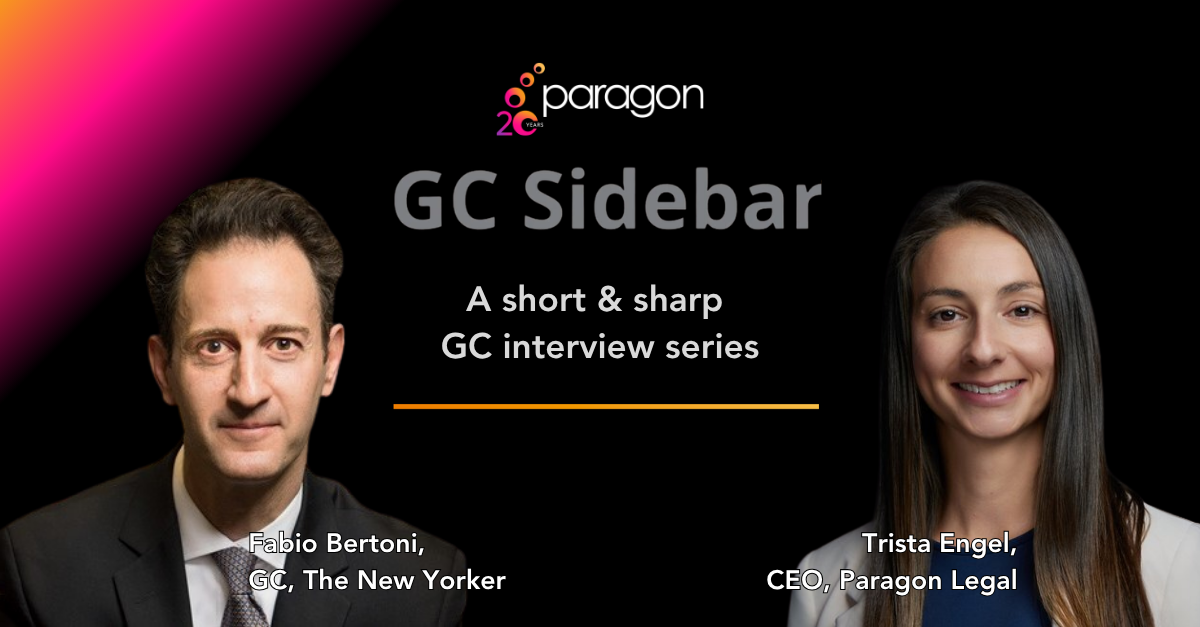
In this GC Sidebar Season 2 episode, Paragon Legal CEO Trista Engel speaks with Fabio Bertoni, General Counsel at The New Yorker, about leadership and the realities of practicing law inside a leading journalism organization.
With experience as both a journalist and a lawyer, Fabio shares what’s top of mind for 2026, including growing legal pressures on reporters and how legal teams help protect investigative journalism.
He also discusses a key lesson from his career as a general counsel: legal advice only works when it’s grounded in the needs of the business. Fabio reflects on his path from journalism to law, how he approaches resourcing and delegation, and the mindset shift that comes with moving in-house.
He also shares what he might be doing if he weren’t a lawyer and the early in-house lesson that shaped his approach to legal work.
Watch the full episode now.
Read the Full Conversation
Prefer reading over watching? Below is the complete transcript from our GC Sidebar interview with Fabio Bertoni, General Counsel at The New Yorker.
Trista Engel:
Welcome to GC Sidebar, a short and sharp conversation series with leading general counsel about the decisions, reflections, and people behind the title.
I’m Trista Engel, CEO of Paragon Legal. Today I’m joined by Fabio Bertoni, General Counsel at The New Yorker, the iconic magazine behind some of the most influential journalism in the world.
Uniquely trained as both a lawyer and a journalist, Fabio has overseen legal review for many of The New Yorker’s most significant investigations, and he’s also written for NewYorker.com himself. Fabio, thank you so much for being here.
Fabio Bertoni:
Thanks for having me, Trista.
Trista Engel:
Let’s jump in. What’s one thing you’re most focused on for 2026, and why?
Fabio Bertoni:
There have been a lot of changes in media law over the last few years, and the pressures have increased significantly. As an in-house lawyer, one of my skills is triaging problems and deciding which ones I don’t need to worry about. But the set of problems I do have to worry about has expanded.
Recently there was an FBI raid on a Washington Post reporter’s home, where computers and phones were seized. That’s under litigation. Don Lemon was arrested, and another independent reporter was arrested while covering a protest. Those are things reporters routinely do, and it feels like an escalation of pressure on the press.
This is also happening alongside lawsuits against major outlets like ABC and CBS. So what I’m focused on this year is anticipating increased risks to our reporters and putting plans in place to deal with those risks.
We’re not going to change what we report on. But we do need to make sure we’re doing that work in the safest way possible.
Trista Engel:
That’s very sobering in many ways.
Fabio Bertoni:
It is. That’s what I’m thinking about. That’s what keeps me up at night.
Trista Engel:
It really puts into the spotlight how important the work that you do and that the The New Yorker does is, and that journalists do across this country, and, many of these conversations, we’re talking about AI, and we’re talking about regulation, and we’re talking about legal work, and all these things that are really important in our industry. But for you, that takes on such a different weight, and it’s much bigger than any individual thing. It’s much bigger than any one of us, but it’s so meaningful and important.
Fabio Bertoni:
I certainly feel that way. It’s why I can work as hard as I do, and do the work that I do, because I really care about it, and I do feel it’s important. So, in some ways, that makes my job easier. I don’t feel like I’m wasting my days at all.
Trista Engel:
Absolutely, and it benefits us all, so thank you.
What’s the most valuable lesson you’ve learned as a GC?
Fabio Bertoni:
The biggest lesson is that if you’re just giving pure legal advice, you’re not really doing your job.
You need to deeply understand the client, what matters to them, and the broader goals of the business. Your legal advice has to be delivered in that context.
At a law firm, you can focus on explaining the law in detail. But in-house clients don’t want a long lecture about legal theory. They want the answer to their question right away. And often you have to provide that answer without perfect information.
Your advice should be grounded in the law but tailored to what the client actually needs.
Trista Engel:
That’s such an important lesson, and can be a hard one to learn, but communicating in a way that your audience will hear and digest, and especially in the context of giving legal advice and business advice, it’s really important that they digest and understand and can utilize the message. So that’s great advice.
What’s one career moment that changed your trajectory?
Fabio Bertoni:
Before law school, I was a journalist and planned to continue in journalism. I thought law school would simply make me a better reporter by improving my research and analytical skills.
But during my third year of law school, I worked in a housing court clinic and an SSI benefits clinic. That experience changed everything.
I realized two things. First, I might actually be a better lawyer than I was a journalist. Second, I felt the immediacy of helping someone solve a real problem.
I showed up in housing court and stopped evictions. That instantly changed someone’s life. I also argued an SSI benefits case before an administrative law judge and won. The judge complimented my presentation.
That was a turning point. It made me realize I could do this work and actually make a difference.
Trista Engel:
It sounds like you discovered a real sense of purpose in the work.
Fabio Bertoni:
Absolutely. Even though those cases weren’t related to journalism, I’ve always cared deeply about journalism. Being able to combine the two later in my career has been incredibly meaningful.
Trista Engel:
GCs today have a wide range of resourcing options beyond FTEs and outside counsel. What’s your approach to resourcing your legal team?
Fabio Bertoni:
I’m very fortunate to be part of Condé Nast. While I operate independently as General Counsel for The New Yorker, I can delegate work that isn’t specific to the magazine to colleagues at Condé Nast or our parent company.
That allows me to focus on the issues that matter most to The New Yorker.
Earlier in my career, when I was at American Lawyer Media, I was much more of a generalist. I reviewed reported pieces and handled media law, but I was also managing office leases and vendor contracts.
Here, I’m able to focus much more on journalism-related legal issues.
I also work with an excellent lawyer on my team. Finding talented people and letting them do their jobs is key. Lawyers often have a tendency to micromanage, and I’m no exception. But good management means trusting people and not slowing them down.
Trista Engel:
We talk a lot at Paragon about “right-sourcing” work. It’s about putting the right work in the right hands at the right cost. Delegation is a big part of that.
Fabio Bertoni:
Exactly.
Trista Engel:
If you weren’t an attorney, Fabio, what would you be?
Fabio Bertoni:
I’d probably be a reporter or writer.
Even though I’ve been a lawyer for almost 30 years, writing has always been part of my life. I’ve written several pieces for The New Yorker’s website on legal and First Amendment issues.
Earlier in my career, I wrote a book review column for a magazine published by the New York Law Journal. I’ve also written essays for other publications.
It’s mostly nonfiction, but writing is something I keep coming back to.
My real dream, though, is to be an old Italian man with a tomato garden.
Trista Engel:
I see both of those in your future. You’re already close to the writing career, and the tomato garden sounds like a great goal, though it might be tricky in New York City.
And the bonus question, Paragon turns 20 this year. What’s one memory from 20 years ago that still stands out to you?
Fabio Bertoni:
Twenty years ago I made my first move in-house, leaving a law firm to join American Lawyer magazine as Deputy General Counsel.
I remember during my first week, the General Counsel told me we had a dispute with a subscriber who didn’t want to pay a few hundred dollars for their subscription.
Coming from a law firm background, I said, “But that can’t be worth my time.”
She replied, “You’re in-house now. Everything is worth your time. This is the business.”
That moment really shifted my perspective. When you’re in-house, there’s no such thing as something being beneath you.
You have to jump in and deal with whatever comes up.
Trista Engel:
Nothing more humbling than that introduction to in-house life.
Fabio, this was really fun. Thank you so much for sharing your story and your insights today.
Fabio Bertoni:
Thanks, Trista. This was great.
Trista Engel:
That’s a wrap on today’s episode of GC Sidebar. Catch more conversations on our website at paragonlegal.com. Thanks for tuning in.




 Employee Portal
 Apply
Apply