Most in-house counsel jobs are full-time and permanent, but a growing number of attorneys are also entering in-house work through flexible and interim engagements that let them join a team for a defined project without a permanent hire on either side.
Plus, there’s currently a sharp jump in demand for attorneys who bring business acumen and cross-functional experience to the table.
This guide covers the current hiring trends, the skills general counsel actually care about right now, and how to make the shift from a firm to an in-house role, so you can land the right attorney job for you.
2026 Trends for In-House Counsel Roles
In-house legal teams are becoming leaner and more integrated with business operations. Today’s corporate counsel are expected to support procurement, manage risk, give legal advice, and collaborate cross-functionally.
Major trends shaping the in-house counsel field in 2026 include:
Expanded roles. Former law firm attorneys are transitioning into in-house positions such as senior corporate counsel, assistant general counsel, and commercial counsel, often specializing in contracts, partnerships, and regulatory compliance.
High-demand sectors. Industries like tech, healthcare, real estate, and nonprofits are actively hiring legal professionals, particularly those with skills related to data privacy, AI governance, and evolving regulatory requirements.
Flexible work environments. Remote and hybrid in-house legal roles are now standard, opening up career opportunities beyond major metro areas.
Rise of interim positions. Project-based roles continue to gain traction, so companies can scale their legal support efficiently without long-term commitments.
Competitive compensation trends. The average U.S. in-house counsel salary reached $180,880 in July 2026, with standard ranges between $167,095 and $200,746.
Salary growth. Total compensation for in-house counsel has grown by 3.5% in 2026.
How To Transition From Law Firm To In-House Counsel
Transitioning from private practice to in-house counsel means changing your mindset from legal depth to business alignment. Here’s how to do it and what to expect.
Law firm jobs have billable hours, client service, and legal specialization. In-house lawyers, on the other hand, are embedded in business teams. They support commercial contracts, advise internal stakeholders, support policy changes, and help drive strategy for the company. Plus, business acumen is a huge part of in-house counsel.
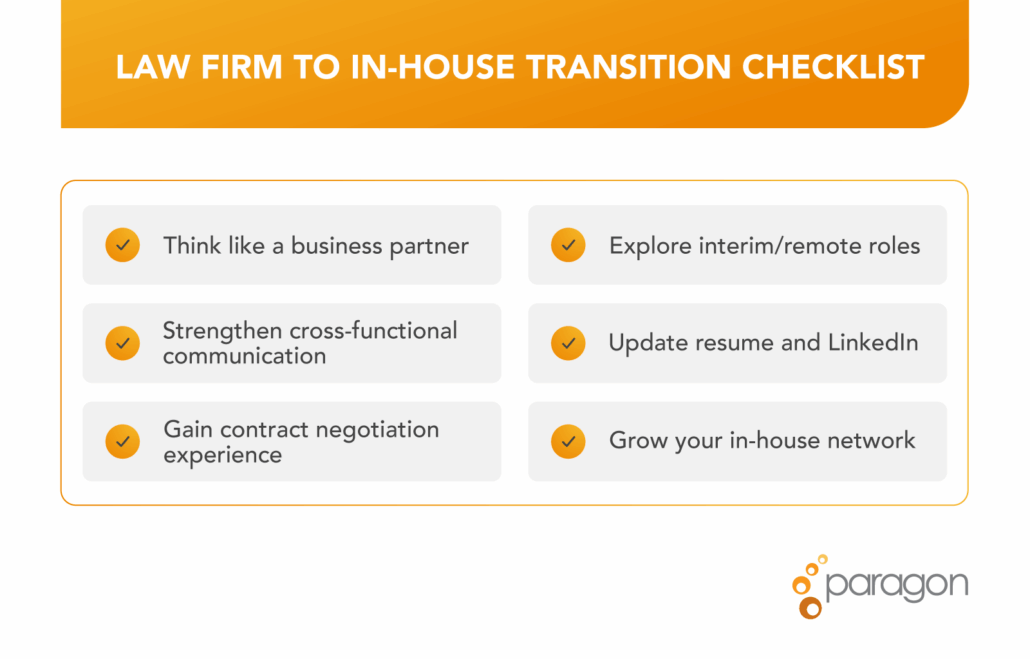
To successfully move from law firm work into an in-house role, focus on building business-adjacent skills and gaining relevant experience through flexible entry points:
Think like a business partner. Match your legal work with company goals and commercial outcomes.
Build internal communication skills. Translate complicated legal matters for HR, finance, operations, and leadership.
Strengthen contract and negotiation experience. Emphasize commercial advising and vendor interactions.
Start with interim projects. Flexible positions provide hands-on in-house experience without the long-term leap.
Refresh your resume and LinkedIn. Highlight transferable skills and reframe your trajectory toward corporate counsel.
Expand your network. Engage with in-house attorneys and attend legal community events, like those hosted by the Association of Corporate Counsel.
Emphasize Transferable Strengths
Law firm experience builds a strong foundation; many of the skills you’ve developed translate seamlessly into in-house counsel roles when framed effectively, such as:
Client management. Your law firm experience with clients maps directly to internal stakeholder relations.
Legal writing and analysis. Core to both firm and in-house roles.
Cross-functional communication. Essential for collaboration across business units.
Business mindset. Show how you understand procurement, partnerships, and risk.
Flexibility. In-house teams value attorneys who can work across diverse legal areas.
Skills and Qualifications Companies Want in 2026
The ideal candidate for in-house counsel jobs combines in-depth legal knowledge with strategic business support. While technical expertise remains foundational, soft skills and tech fluency are becoming just as vital.
Top Legal Skills in Demand
Attorneys looking to pivot into or advance within corporate roles should demonstrate hands-on experience in:
Commercial contracts. Drafting, reviewing, and negotiating agreements across functions.
Corporate governance. Advising boards and meeting the organization’s legal responsibilities.
Employment law. Managing workplace policies and partnering with human resources on sensitive issues.
Compliance. Implementing policies aligned with applicable laws and industry regulations, including internal investigations.
Intellectual property. Protecting company innovations and trade secrets.
Preferred Qualifications
Most in-house legal departments seek attorneys with a Juris Doctor degree and five or more years of experience after law school. Companies also favor professionals who bring relevant certifications, such as:
Bar admission in good standing; mandatory for legal advice roles
Tech Fluency Matters, Too
Familiarity with legal tech and privacy frameworks is now a major asset, especially as AI tools influence everything from contract analysis to compliance reviews. Attorneys well-versed in how AI intersects with applicable laws, especially around consumer data, stand out as more future-ready.
Flexible and Interim Opportunities Through Paragon Legal
For attorneys seeking in-house experience without a permanent leap, flexible and interim roles through Paragon Legal offer a smart, low-risk path to build corporate counsel credentials and work directly with legal departments.
Interim attorney positions offer attorneys a compelling way to gain meaningful in‐house experience while bridging from law-firm work or exploring a new career path in corporate counsel roles.
These project‑based roles let you work within a legal department, advise stakeholders, and take on in‑house counsel jobs without the full commitment of a permanent corporate hire.
Attorneys Who’ve Made the Move
Keith F. A veteran of 20 years in commercial, intellectual property and privacy law, Keith spent eight months embedded with an emerging biotech company supporting clinical trial completions, building export compliance processes and negotiating vendor and commercial agreements.
Carolyn S. Carolyn brings over 20 years of experience to her work, including 18 months spent supporting licensing and research agreements for a biotech company. During that time, she worked on material transfer, clinical trials, and supply chain issues.
Where Paragon Places Attorneys
Paragon Legal works with many different industries and sectors to place attorneys in specialties where they can thrive. A few of the main company types in Paragon’s network:
Fortune 500 companies. For example, a Fortune 500 biotech company needed help building a privacy program from scratch. Paragon placed a senior privacy attorney who developed the program over six months, then stayed on to update policies and support GDPR compliance in the UK.
Established companies. For instance, one of the nation’s top fintech lenders needed to build out its procurement team. Paragon assembled a three-person team, including a procurement lead with fintech industry experience, to handle vendor agreements and data privacy contracts.
Startups. For example, a cybersecurity startup with a two-person legal team needed interim coverage during a leave of absence. Paragon placed an attorney who oversaw the company’s service agreements and contracts, and also weighed in on employment questions and other corporate matters.
How Paragon’s Process Matches Legal Talent With Corporate Clients
Here’s a breakdown of how Paragon works with attorneys and corporate legal teams:
Take a look at our opportunities page, where you’ll find positions we’re currently looking to fill (it changes frequently, so be sure to check back often) and apply.
If your background is a fit for Paragon, our sourcing team will schedule a 20-minute phone interview to learn more about your recent practice, availability, and interest in project-based work. During the call, we’ll share information about our process, our typical projects, and an expected compensation range, and answer any questions you have.
If there’s mutual interest after the phone interview, we’ll add you to the Paragon network and screen your profile for all incoming projects. If there’s a project that looks like a good match for your background and preferences, we’ll share the details and ask you for more information about your relevant experience.
If you’re interested and available for the project, and it seems like it would be a good fit, you’ll meet one of our recruiters for a video interview. We’ll share more information about the project and what the client is looking for and gather more information from you, so we can best represent your candidacy to the client.
If we’re confident that you’re a good match for the position, we’ll submit your information to the client. If the client is interested in interviewing you, the next step is a personalized prep call with your recruiter. They’ll offer insights and helpful tips, answer any questions you have, and wish you good luck. You’ll also have access to the Paragon Interview Prep Guide, with tips on what to do before, during, and after an interview.
If you’re selected for the project, your recruiter will call to share the great news. Your onboarding with Paragon starts right away, including offer paperwork, background and references checks, and orientation. You’ll be simultaneously connected with your attorney development contact, who will walk with you through onboarding with the client and help ensure a smooth project kickoff.
Advantages of Choosing Flexible or Interim Roles
Here are some of the key benefits for attorneys and corporate clients:
Unique assignments. You can work across different industries, legal team structures, and practice areas, gaining a breadth of in‐house experience.
Flexible work. Many roles allow hybrid work or remote arrangements, so attorneys can balance professional life with personal priorities.
Improved work‑life balance. Project‑based timelines or part‑time hours give you control over when and how you work.
Exposure to established corporate legal teams. You’ll work alongside in‑house counsel, general counsel, and internal stakeholders, strengthening your corporate counsel profile and network.
How Paragon’s Model Supports Businesses
Paragon offers a flexible legal talent solution that helps in-house teams respond to shifting demands without sacrificing quality or continuity:
Paragon’s project-based roles enable legal departments to scale up quickly when business needs fluctuate, such as during M&A, regulatory changes, or interim transitions.
Companies gain access to vetted attorneys with relevant experience without committing to a full‑time hire or outside law firm contract.
The flexible model improves efficiency, as legal teams can tap talent when needed and shift back to core staffing when project volumes normalize.
Tips for Remote and Hybrid In-House Counsel Jobs
Remote in-house roles have become standard in 2026, particularly in sectors like SaaS, finance, healthcare, and real estate. These industries value flexible legal support for contracts, compliance, data privacy, and employment issues, making remote or interim roles an ideal fit.
However, remote work brings challenges, such as maintaining confidentiality, strong tech fluency, and detailed communication. To succeed, attorneys must:
Set boundaries. Protect your schedule to maintain work-life balance.
Stay visible. Keep in touch with regular updates and check-ins.
Find mentorship. Build relationships with experienced in-house attorneys.
Sharpen communication. Be clear and responsive in written and verbal updates.
Stay flexible. Try roles across different industries to grow your impact.
Get the setup and mindset right, and remote legal work offers meaningful career growth and flexibility.
Salary Expectations and Career Growth
When attorneys transition from law firm work to in‑house counsel jobs, understanding the compensation (and how it varies by role, region, and corporate maturity) becomes important for positioning yourself effectively in the hiring process.
Here’s a quick summary of typical in-house counsel compensation across major U.S. markets:
Regional Salary Comparisons
Role
Region
Approximate base salary*
Assistant/Associate General Counsel/Senior In‑House Counsel
California
~$199,511 average for “In‑House Counsel” roles as of July 2026.
Assistant/Associate General Counsel/Senior In‑House Counsel
New York City
~$208,264 average for “In‑House Counsel” roles as of July 2026.
General Counsel/Deputy General Counsel (Large corporation)
*These figures reflect general counsel‑type roles or senior in‑house counsel; smaller corporate counsel roles will fall below these averages.
Negotiation Strategies and Long‑Term Growth Tips
To position yourself for growth and negotiate effectively:
Connect your background to business needs. Frame your legal experience in terms of stakeholder collaboration, hybrid-readiness, and prior flexible roles.
Use regional benchmarks. Reference compensation data from high-cost markets like New York or California, especially for roles with national scope.
Request full transparency. Clarify all compensation components, including base, bonus, stock options, remote perks, and professional development.
Show commitment. Express interest in advancing along the corporate counsel track and ask about promotion timelines and typical experience at each level.
Negotiate beyond salary. Consider benefits such as hybrid schedules, titles, or role flexibility as part of your total package.
Next Steps for Attorneys Exploring In-House Roles
In 2026, attorneys have more ways than ever to align their careers with changing business needs, thanks to the growing demand for in-house counsel and the rise of flexible roles.
To succeed, highlight key skills like commercial contracts or employment law, along with adaptability and strong communication. Whether you’re new to in-house or transitioning from a firm, flexible attorney jobs offer a low-risk, high-value way in.
Check out open in-house counsel jobs on Paragon Legal’s Opportunities page to see how you can match with roles that fit your goals and lifestyle.
FAQs About In-House Counsel Careers
Considering a move into an in-house counsel role? Here are answers to common questions attorneys have about responsibilities, qualifications, and how to get started.
How to find in-house counsel jobs without in-house experience?
You don’t need prior in-house experience to land your first corporate counsel role, just a strategic approach. Here’s how to get started.
What does an in-house counsel do?
In-house counsel are attorneys employed within a company to handle its legal needs from inside the business rather than at an outside firm. Depending on experience, they handle work like contract review, compliance, employment law, and risk management, partnering closely with teams such as HR and product. While most in-house roles are permanent, some attorneys take on this work through interim or project-based engagements.
How to find in-house counsel jobs without in-house experience?
You don’t need prior in-house experience to land your first corporate counsel role, just a strategic approach. Here’s how to get started:
Pursue project-based roles. Temporary or interim legal assignments through platforms like Paragon Legal give you direct exposure to corporate legal teams without long-term commitment.
Tailor your application materials. Highlight transferable skills, like contract negotiation and cross-functional communication, and show how you’ve supported business teams, even in a firm setting.
Engage with Paragon’s community. Take advantage of job alerts, networking events, and peer engagement to grow your in-house presence.
Be proactive. Set alerts for interim counsel roles and regularly check Paragon’s Opportunities page for assignments that match your skills.
What skills are essential for an in-house counsel position?
In-house legal roles demand more than just legal knowledge; they require business fluency and cross-functional collaboration. Key skills include:
Contract drafting and negotiation. Especially vital in regulated industries or those with complex vendor ecosystems.
Clear communication. Translate legal advice into actionable guidance for HR, finance, operations, and other teams.
Tech and compliance awareness. Familiarity with AI tools, data privacy laws, and compliance strategy is increasingly expected.
Business acumen. Understand how legal decisions affect revenue and growth.
Adaptability. Thrive in fast-changing conditions and support shifting business goals.
To stand out, emphasize how your legal work has delivered measurable business impact.








 Employee Portal
 Apply
Apply