In-house legal teams often face a familiar challenge: keeping up with the demands of everyday business contracts while being able to devote time and resources to more complex commercial agreements. Whether you’re dealing with SaaS licensing, supply chain negotiations, or vendor contracts in the e-commerce space, the workload can quickly outpace internal capacity, especially for small business or startup teams without deep commercial expertise.
The smart solution? Hiring a commercial contracts attorney on demand. These attorneys work alongside your in-house team, offering the contract law expertise you need to handle business transactions efficiently, without adding a full-time salary or paying the high fees of a traditional law firm. With flexible legal services from Paragon Legal, companies gain rapid access to experienced contract attorneys who can work remotely or on-site across the U.S., depending on your team’s preference and needs.
What Does a Commercial Contract Attorney Do?
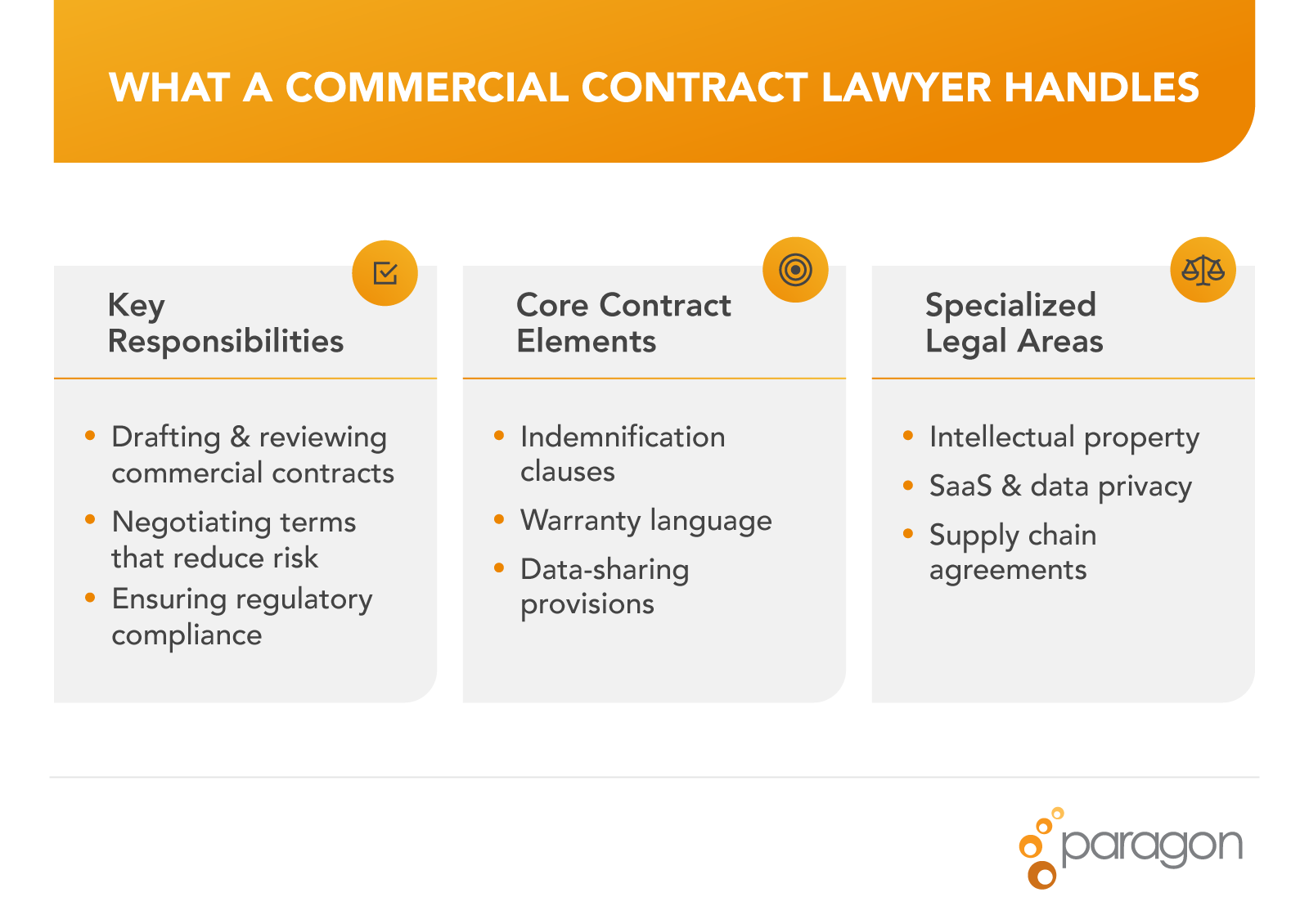
A commercial contracts attorney helps businesses manage the legal side of commercial operations. These attorneys handle the practical side of commercial contracts, like drafting, reviewing, and negotiating terms that protect their clients and meet regulatory standards.
In practice, that can mean sorting through details like indemnification clauses, warranty language, and other provisions designed to limit risk and avoid future disputes. They are also adept at identifying legal exposures and clarifying responsibilities in complex agreements, such as SaaS licensing or data-sharing arrangements — tasks that require more than general legal knowledge. Unlike in-house generalists, commercial contract attorneys focus specifically on the agreements that drive revenue and operational momentum. They typically have years of in-house experience reviewing, drafting, and negotiating a wide range of commercial agreements, which gives them a deeper understanding of deal structure, risk, and practical business needs. Their years of experience often span multiple industries, including cybersecurity, manufacturing, and e-commerce, making them highly valuable partners for fast-moving teams or companies scaling their operations.
Common Types of Commercial Agreements They Handle
Most companies rely on contract attorneys for a wide range of agreements that support business growth and legal compliance. From distribution agreements to development agreements, each contract type plays a specific role in a company’s operational strategy.
Below are common types of commercial contracts an attorney may handle:
Sales and purchase agreements. Define the terms for buying or selling goods and services in business-to-business transactions.
Licensing and intellectual property agreements. Outline usage rights, ownership, and protections related to IP — essential in commercial law and brand security.
Vendor and supply agreements. Establish responsibilities, warranties, and liabilities to manage supply chain relationships effectively.
Employment contracts and consulting agreements. Clarify duties, compensation, confidentiality, and duration for internal and external personnel.
Master service agreements and development agreements. Provide scalable frameworks for long-term collaboration with service providers and distributors.
Nondisclosure agreements, indemnification clauses, and disclaimers. Limit liability and protect proprietary information, often included in more complex business transactions.
When Should a Business Hire a Commercial Contract Attorney?
It’s usually best to bring in a commercial contracts attorney before any problems surface. Legal guidance becomes especially valuable when a company is growing, entering new markets, managing multiple vendors, or going through mergers and acquisitions, which are situations that often involve complex agreements beyond the scope of standard contracts.
For smaller businesses and startups, an attorney can help build a strong foundation from the start. That might mean working through partnership terms, setting expectations with new suppliers, or making sure your intellectual property stays protected. SaaS companies often look for guidance on things like user agreements, service-level standards, and privacy rules, while larger organizations usually need extra legal help during busy contract seasons — renewals, audits, or procurement planning, for example.
Hiring an attorney before signing high-value or long-term contracts, particularly those tied to supply chains or sensitive data, can prevent future disputes and ensure regulatory compliance. A seasoned commercial contracts attorney understands how to negotiate terms that support your goals and limit exposure to risk.
How To Hire the Right Commercial Contract Attorney on Demand
Hiring a commercial contracts attorney doesn’t have to be a lengthy or complicated process. With the right approach, in-house teams can make fast, strategic hiring decisions that strengthen corporate transactions and improve legal outcomes.
Step 1: Assess Your Legal Needs
Begin by spotting any gaps in legal coverage and identifying which contracts need attention, like development or purchase agreements. Take stock of how often your team handles repeat legal work in areas such as supply chain management or data privacy, and assess both the volume and value of agreements to understand the risk profile of each. From there, decide if your business would benefit more from short-term help or a long-term partnership for ongoing legal support.
Step 2: Vet Experience and Industry Knowledge
Look for attorneys who know your industry inside and out — whether that’s health care, consumer packaged goods, or professional services. Paragon Legal handles much of this vetting process for you by evaluating attorneys’ past work, client feedback, and adaptability. Paragon will also verify their credentials, how long they’ve been practicing, and their level of expertise with the kind of contracts your business depends on.
Step 3: Compare Flexible Engagement Models
Paragon Legal connects businesses with contract attorneys through flexible and affordable staffing options. In-house teams can tap into experienced talent without taking on the expense of a full-time position or a traditional firm. With clear pricing, adaptable scheduling, and defined deliverables, Paragon makes it easier to stay on budget and manage projects efficiently.
Step 4: Ensure Remote or On-Site Compatibility
Legal support today should move at the same pace as your team. Paragon attorneys can join remotely or on-site, depending on what works best for your organization. They fit naturally into existing systems, working alongside in-house teams across the U.S. to keep projects running smoothly without slowing productivity.
Why Businesses Choose Paragon Legal
Paragon Legal was built on a simple belief: There’s a better way to complete your team. That means giving in-house teams flexible access to experienced legal professionals, without the long-term costs or rigidity of traditional staffing models.
When a company needs support with commercial contracts, compliance matters, or other areas, Paragon provides attorneys who can step in and work seamlessly with in-house teams. They bring a strong background in contract work, helping to ease the pressure on internal resources by clearing backlogs, improving efficiency, and keeping operations running smoothly.
Paragon supports a wide range of industries with nationwide availability. Clients trust Paragon for reliability, responsiveness, and a professional approach that supports in-house teams.
Partner With Experienced Commercial Contract attorneys
Flexible legal staffing saves money while boosting compliance, efficiency, and speed across multiple practice areas. By partnering with a commercial contracts attorney through Paragon Legal, companies can manage contract volume and maintain momentum during busy cycles or team transitions.
With years of experience supporting corporate legal teams, Paragon attorneys offer deep knowledge, strong communication skills, and adaptability. Whether you’re a fast-growing startup or a Fortune 500 legal department, Paragon’s professionals deliver high-value support across business needs.
FAQs About Commercial Contract Attorneys
These FAQs address some of the most common questions businesses have when exploring flexible legal staffing and on-demand contract attorneys.
How much does a contract attorney cost?
The cost of hiring a contract lawyer can vary depending on factors such as their years of experience, the complexity of the agreements, and the billing model used. Some law firms charge hourly rates, while others may offer project-based or retainer pricing for ongoing professional services.
Paragon offers clear, flexible billing options to match the needs of each engagement. With Paragon Legal’s flexible staffing model, companies often save significantly on legal expenses, particularly compared to traditional law firm rates. Depending on the engagement, businesses can save anywhere from 20% to 50% on these matters, making Paragon an efficient choice for in-house teams managing budget and scale.
How do I choose the right commercial contract attorney for my business?
Choosing the right commercial contract attorney starts with identifying your contract needs, then matching them with someone who has both the right experience and communication style. Look for attorneys who are flexible, easy to collaborate with, and familiar with your industry’s specific legal challenges.
Client testimonials or real-world examples can offer valuable insight into how an attorney operates. Paragon Legal pairs companies with professionals who have deep in-house experience in relevant niches, providing scalable support without sacrificing quality.
What’s the difference between temporary and freelance contract attorneys?
While these terms are often used interchangeably, they refer to different engagement models and working relationships:
Temporary contract attorneys. These attorneys are typically hired for a fixed time period to cover leave, support overflow work, or assist with short-term legal needs. They may work full-time hours, but are not permanent employees and are usually placed through staffing agencies.
Freelance contract attorneys. Freelancers operate independently and often take on multiple clients. They usually work project-to-project, handle ad hoc matters, and are typically engaged as 1099 independent contractors rather than employees.
Paragon Legal contract attorneys. Paragon’s attorneys are W-2 employees with extensive experience who work a minimum of 10 hours per week and receive benefits. They are embedded directly into in-house legal teams and provide ongoing, scalable support, making them an integrated, long-term solution.






 Employee Portal
 Apply
Apply